Four: Storm

I am sitting in a grassy field under a small tent. A young nurse is taking my blood pressure. She is dressed in army fatigues, like one of the nurses from the old television show M*A*S*H. It is sunny and the light is very bright. She is talking to me, her voice muffled like we are under water. There are no other sounds. No birds singing, no traffic, no other voices. We are alone.

“We are going to get you to a room soon honey, okay?”

“My head hurts.”

And later:

I am lying in a bed somewhere. My head feels as if it were in a vice. I hear my son’s voice.

How you feelin’ dad?”

“I don’t know what to do. They gave me all these COVID kits to put together, and the instructions are in Chinese. Can you help me figure it out?”

I would later learn that the first memory never happened. I was admitted to the hospital by standard procedure, through the emergency room.

The second did. My son found me babbling like that the next day. I had received no treatment up to that point. My fever had spiked to 103.

I remember almost nothing about what transpired in the week that followed. Most of what I write reconstructed from The Book. Other things were false (or no) memories that the Redhead explained in the days and weeks afterward.

No, family did come to see you, you talked to them. Yes, you did have your phone, but I did not see you look at it. Yes, you were awake a good bit of the time. Yes, we talked about a lot of things. No, they did bring you meals. Don’t you remember any of that?

I did not. I do not.

The Book has pages and pages of tests. Bizarre imbalances in blood profiles. Some categories were extremely low, others alarmingly high. There were also MRIs, CT scans, and ultrasounds.

They were looking for West Nile virus, but that test was negative. They considered meningitis, but never did a spinal tap (an error, given what was to come). The baffled internist bowed out and referred me to the “Infectious Disease Expert.”

After four days of intravenous antibiotics and fluids, the blood tests returned to normal.

A memory, confirmed to be true:

I am sitting in a chair and a doctor is speaking to me in a quiet voice.

“Mr. Clifton you have been an extremely sick man. We have done a lot of tests, but we do not know the cause. I suspect it may be related to the tick bite you had, but tick-borne infection tests must be sent to a lab in Virginia. It will be two weeks before the results come back. Until then, I am giving you a prescription for one week of Doxycycline just in case. By the way, I noticed from your chart that you haven’t had your COVID vaccine, and I really think you should consider…”

“No. I am not taking your shot. You should focus on figuring out what I have rather than trying to get me to take some so-called vaccine for something you think I may get.”

“Sir this is not a political thing, but…”

“No, it is not political. End of discussion.”

“Understood. I will call you when your lab results come in.”

Admittedly rude, that. It might have affected our future relationship.

The Redhead drove me home soon afterward, but to this day I do not remember the ride.

Two: The Book

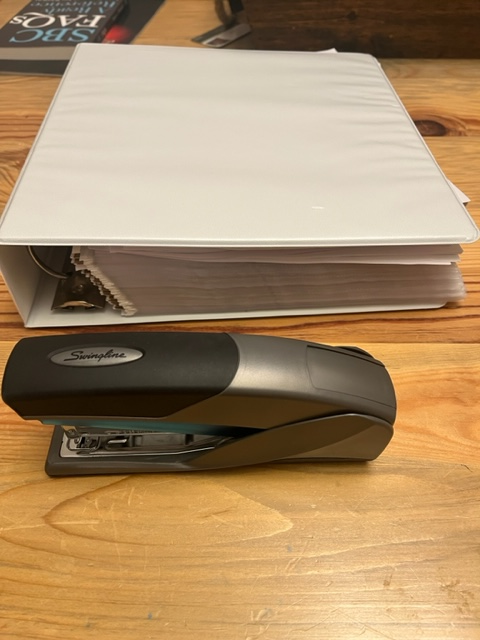
The telling would not be possible without the book. A three-ring binder that serves as a sort of reference manual. Painstakingly assembled by the Redhead, a left-brained mathematical genius who can account for every penny on a balance sheet and has never met an equation she could not solve. Quite a catch for a right-brained word-man who can see the forest from the trees but cannot see the solution for the numbers.

The book is a chronological presentation of every medical visit, every test, every doctor’s summary, over the course of two years. There are spreadsheets she has constructed that compare blood test results by date for every component and how the numbers fluctuate – normal, abnormal, normal, abnormal – clues in search of a crime.

The analysis has been ignored or shrugged off by the medical community, most who seem to be more interested in moving things along so that they can get to the next beef in the slaughterhouse line. Let’s go folks, I have other patients to bill.

I offer this explanation to tell you how I know the order of events. Without the outline, the story is disjointed, the sequence and cadence lost. One of the effects of the illness has been a loss of short-term memory. Names and dates, mostly. I carry a little pocket-journal to help with that. Something a writer should do anyway. Stories and observations are often in the moment, and time blunts the imagery.

It is from this record that I know the exact date that this story began. How I can move from “Once upon a time” to June 5, 2021.

I had spent that week in the office, and a hot, lazy Saturday afternoon was just what the doctor ordered (no pun intended) for a forester and his dog. Just a short walk to a creek through a little patch of woods in Tallapoosa County, Alabama. The dog was protected from fleas and ticks. The forester, not.

An Independence Day

July 1, 2023.

My personal “Independence Day,” in a sense.

I am officially unemployed.

The Redhead is calling it “semi-retirement.”  A good phrase, but not entirely accurate. I am too young to draw my pennies and not well-off enough to quit work for a life of leisure.  My career in forestry has paid the bills, but I did not get rich from it by any stretch of the imagination.

I prefer the term “self-employed,” although I am not entirely sure what that will look like in the days ahead.

There is a story here beyond employment. One I am going to tell only because someone urged me to do so. It will be difficult writing for me because it is about me, and quite frankly there are more interesting things to write about.

It is not a tale to solicit either pity or advice, because I have had plenty of both over these last two years.

Think of it as a cautionary tale, especially if you spend time in the woods and fields of Alabama.  It is a story about chronic illness.

I will write this story as a serial, because it is much too long to hold your attention in one sitting.

It starts like this: “Once upon a time, a forester was bitten by a tick.”

Haircuts and Memories

The weather is hot here in central Alabama, and lately the Redhead has been hinting (well, nagging really) that it’s time to get my “summer” haircut. The summer haircut is an old southern tradition in which men get their hair cut a little shorter than usual for the summer months. In my case, it’s not going to make a lot of difference, because every passing summer leaves me with a little less hair to worry about.

The summer haircut brings back old memories. I hated haircuts as a child. Funny how the passing of the years turns such memories into soft-edged nostalgia.

My dad always took me to a downtown barbershop in Sylacauga back in the late 1960’s, which I believe was located on one of the side streets between Broadway and Norton. This shop was a real man’s haven: three big leather-clad barber chairs, black and white checkered tile floors, and mirrors on the back wall. Other walls adorned with mounted deer heads and a largemouth bass or two, along with an auto parts store calendar featuring a pin-up girl (scantily clad in the latest one-piece bathing suit). In one corner, an old glass-front cabinet filled with creams and tonics that every man needed to keep his coiffure under control. Metal chairs with vinyl cushions lined the waiting area. One or more conversations taking place at all times, usually about football, problems at the mill, or the latest frustrations rebuilding a small block 350 engine. Plenty to read while you waited: Field and StreamPopular Mechanics, and the current edition of the local newspaper, The Daily Home. An old AM radio on the counter, playing good country or gospel music. Depending on the time of day, you might even hear old L.R. Ross tell you what great merchandise was available for sale or trade on the “Shop and Swap” segment on W.F.E.B.:

“Neighbors, we have a man who’d like to trade a real nice goat for a single-shot 12 gauge shotgun. If you have a gun you’d like to trade, please call…”

I can still smell the witch hazel and talcum powder.

Although there were three chairs, I only remember one being used. The barber was old Mr. Mallory. As a little boy, it seemed quite possible to me that he had probably given Moses his first hair cut. Mr. Mallory wore glasses that had lenses as thick as the bottom of an old green glass coke bottle, and the end of his nose was always about an inch from your head while he worked his magic.

Mr. Mallory always asked “How you want it?” The answer never mattered. You might “want it” like Elvis, but you “got it” in a style called “flat top.” I believe it was the cut he liked best. But it was the haircut for the small town southern gentleman at that time. I was always just relieved to leave the chair with both ears still attached. If I didn’t squirm too much during the whole ordeal, I’d get a piece of Bazooka bubble gum as a reward.

Times sure have changed.

The place I go these days for a haircut is a “style shop.” The customers are both men and women, although the barbers are all now called stylist and are exclusively female. The walls are pastel and there are flower arrangements. Something soothing and “New Age” plays on the sound system. The place smells of bleaching chemicals and potpourri. There is no Field and Stream, though if you look hard enough you might find a copy of Time or National Review. The last time I went, the receptionist asked me if I wanted a warm cookie.

My stylist is blond and attractive. She tries to engage me with conversation about American Idol or Dancing with the Stars, but it is to no avail. I have never watched either. Confident that my ears will survive intact, I usually have to fight the urge not to doze off while she works. She always asks if I would like a little mousse or styling gel before I leave. I always decline. As Eastwood said, “A man’s got to know his limitations.”

She and her coworkers are trained psychologists. They tell me how good I look–how my gray hair makes me looked “distinguished.” I am aware that I am being worked for return visits, like a young, pretty waitress works a middle-aged man for a bigger tip.

I’ll admit she does a good job with the little bit of hair she has to work with. But for her skills, she charges a fee that would have probably made Mr. Mallory decide to close up early and take the rest of the day off.

Manhood still barely intact, I leave knowing I’ll have to return in a month or so. I feel a strange urge to go rebuild a small block 350 engine or shoot an animal.

Maybe times haven’t changed all that much over the years.

I still hate haircuts.

This post originally appeared here in 2010.  

The Lunatic

The lunatic sits under the firmament, waiting for the appointed time.

Tonight, both sides of the moon dark.  A blood-moon.  Blood cries from sky as well as the ground.

In a little patch of pasture grass between stands of pine, darkness falls slowly then all at once.  Thunder off to the northwest, air heavy but cool.  Sky thick with clouds.

The first lightning-bugs of the year hover along the tree line.  A visage that once meant empty pickle jars with hole-poked lids.  Remembered days of daisy chains and laughs.  Does it mean anything now?

We are refugees from Babel.  Once sky-gazers, mumbling in strange tongues.  Huddled by fires against the darkness outside animal-skinned shelters.  Looking for a sign from the sky.  Now screen-gazers huddled inside, forsaking all but strange truths.

The appointed time passes, and the clouds will not part. 

The Book says “A wicked and adulterous generation seeketh after a sign.”

The bulldog sighs. 

“Okay,” I say.  “Let’s go to bed.”