“At one time in the world there were woods that no one owned,” wrote Cormac McCarthy in Child of God.
If you want to tell a story, start at the beginning. But there is a problem if your tale is about a forest. When exactly was the beginning?
I once attended a lecture on Alabama’s National Forests at which a government forester claimed that the U.S. Forest Service was enacting a management plan to restore public lands to their “original condition.” I raised my hand and asked when the forest was “original.” After a great deal of stuttering and stammering he admitted that what he really meant was before any logging.
That’s a beginning with which we can work. What did Alabama’s forest look like before anyone owned it – before logging?
My best guess is 1775, the year that naturalist William Bartram documented his travel through central and southern parts of the state. Bartram was a true “Renaissance man,” an explorer, botanist, artist, and writer, and his descriptions and drawings of plants and animals are the definitive narrative of the southern landscape before European settlement.
What Bartram described is something vastly different from what exists today.
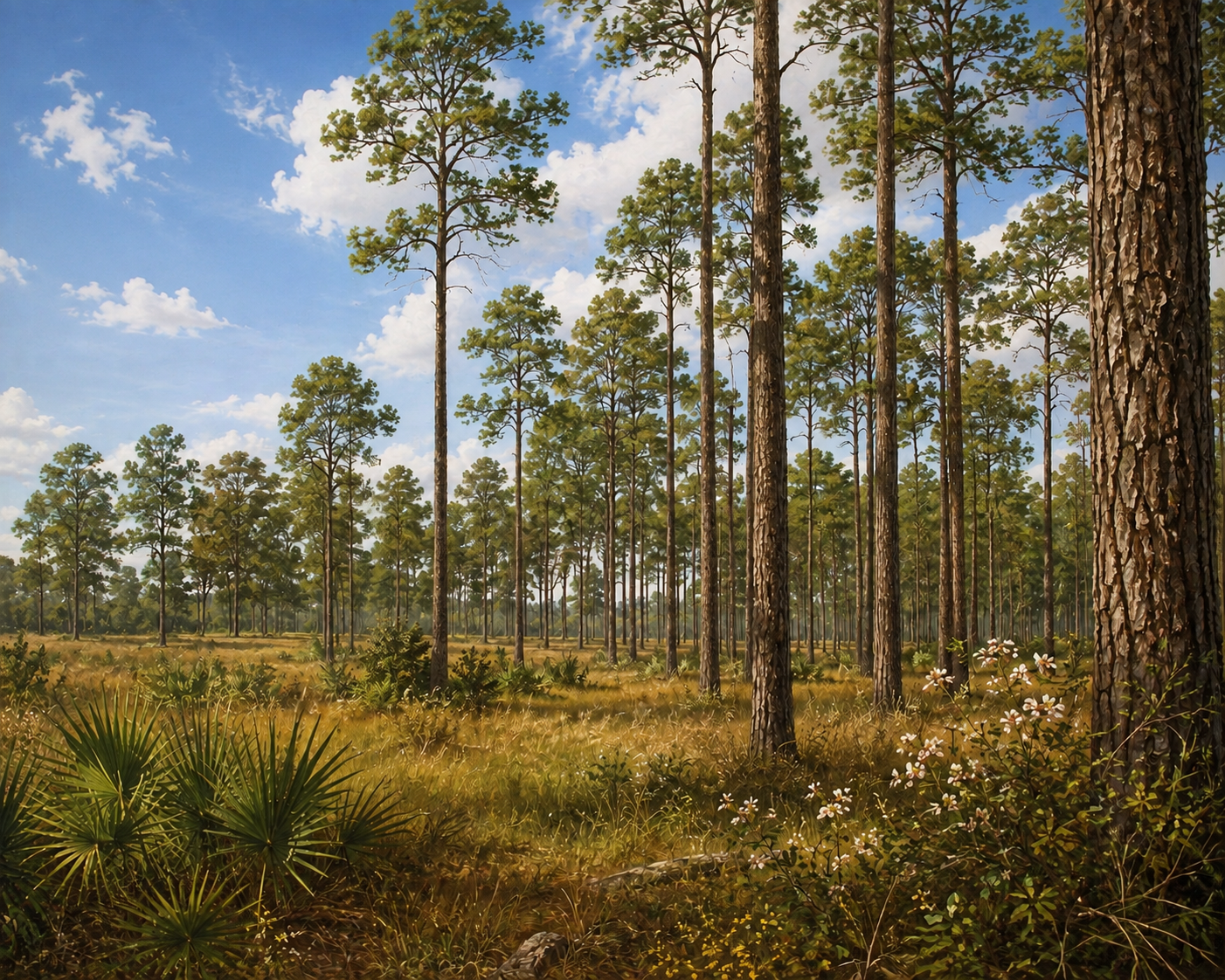
In what we now call the “Coastal Plain” he found longleaf pine savannas, vast areas occupied by “the stateliest pine trees that can be imagined.” This forest was open and prairie-like, with large, widely spaced trees “standing like columns or pillars,” and a ground cover of grasses, wildflowers, and shrubs. The openness of this forest allowed him to travel through on horseback. He accurately surmised that the longleaf ecosystem was maintained by frequent fires, which occurred both naturally and through intentional actions of the natives.
A reasonable estimate of the longleaf forest in Bartram’s time is 30 million acres. Today there are about three million, and much of that consists of young longleaf plantations. There is a lot of interest in restoring the ecosystem, and public and private agencies offer grants and other funding to encourage landowners to plant longleaf.
Along rivers and creeks, he found something entirely different. Great stands of massive hardwood trees including oak, ash, elm, baldcypress, sweetgum, and southern magnolia. Thick vines grew up into the canopy, and the groundcover consisted of ferns and lush vegetation. He described this forest as “cool, shady, and luxuriant.”
The bottomland forest in Bartram’s time is estimated to have covered six million acres. Today there is about 2.7 million, with most of that having been cut at least once.
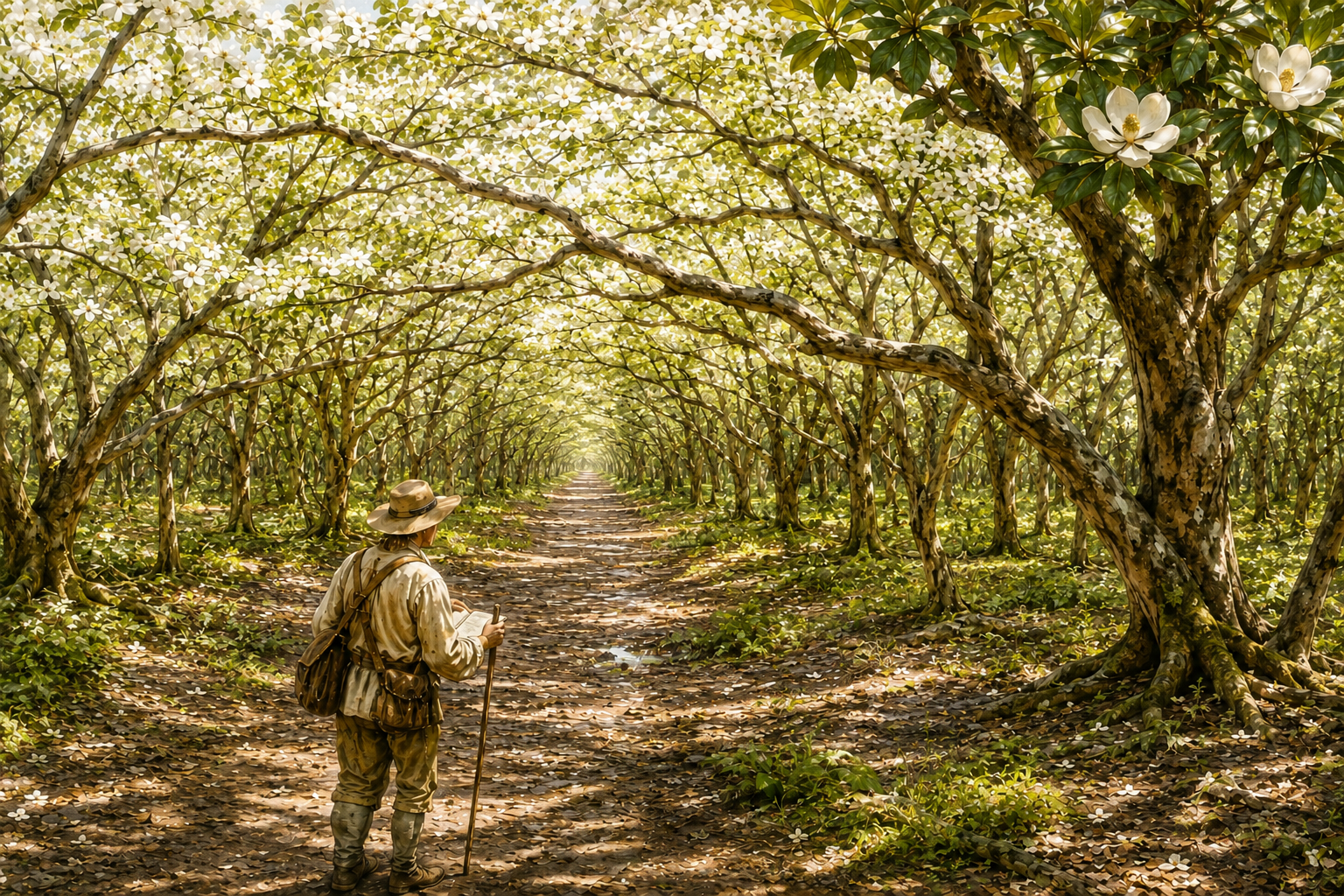
Just south of what is now Montgomery, Bartram described something foresters find puzzling – a nine-mile-long stretch of flowering dogwood trees so dense that it was a monoculture, punctuated occasionally by a southern magnolia. The curious thing about that is that dogwood exists today as individual trees scattered across the uplands. What he described does not exist today.
While Bartram did not travel through the hills and valleys of North Alabama, we can surmise what he might have seen from the writings from settlers in the early 1800s. Oak, hickory, American chestnut, hemlock, and various pine species covered this area. Most has since been cut and regenerated several times, and a substantial portion is now in pine plantations. American chestnut, which may have constituted 30% of this upland forest is extinct, killed by a blight over a couple of decades in the early 20th century.
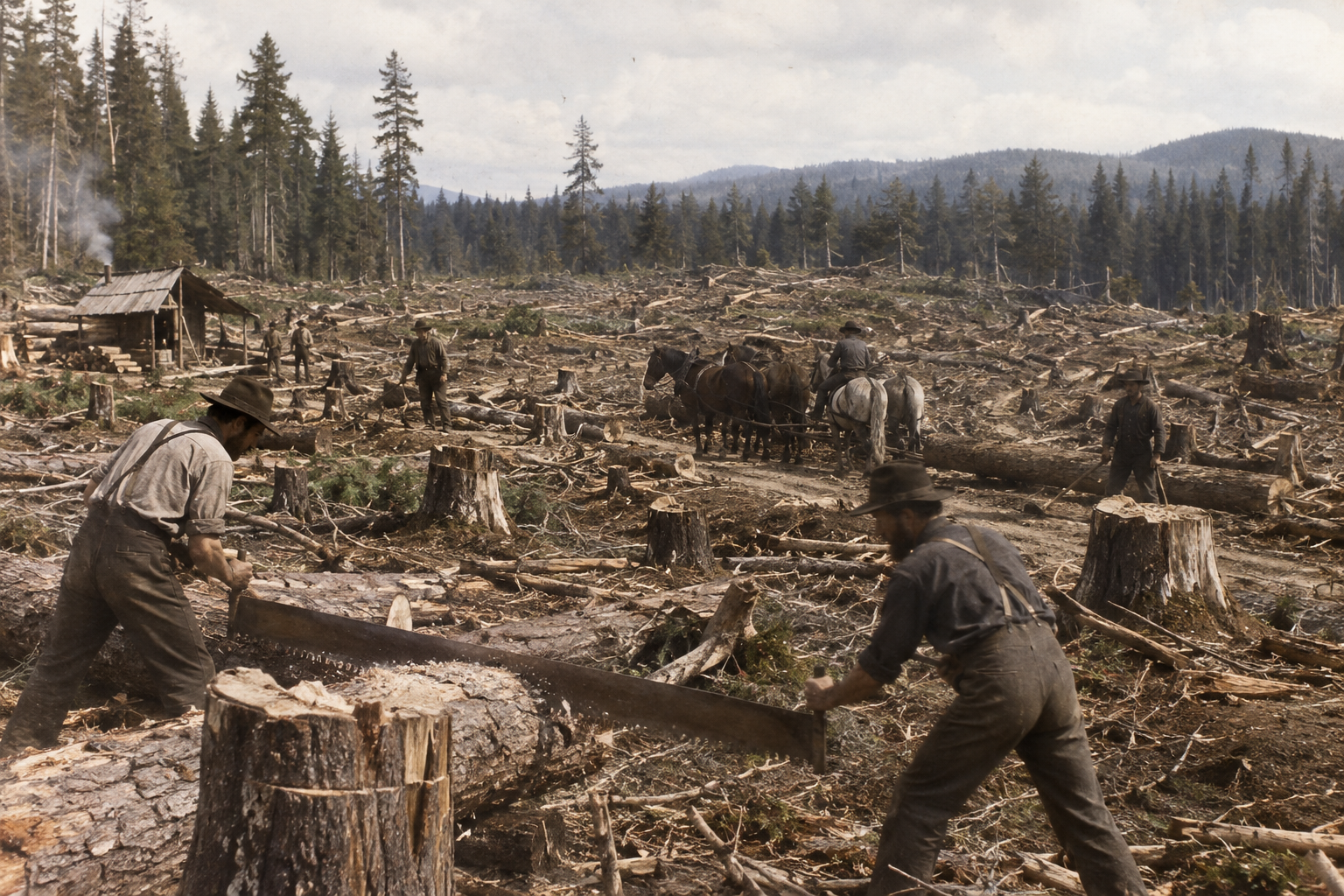
The bottom line: the forests we have today are quite different than the “original.” The terms “virgin forest,” “virgin timber,” or “old-growth timber” simply do not apply in Alabama. Every forested acre that can be logged has been — several times. A tree over 130 years old is rare, and a group of trees that age standing together on an acreage large enough to be considered a forest is non-existent. There are a few exceptions, of course, but they are occupying land that is extremely hard to access – which is why they are still standing. These “patches” of forest exist in areas so steep, narrow, swampy, or rocky that no enterprising timber man ever figured out how to get in to cut them. We have lots of trees, but they are not as old as you might think. Next time I will tell you a little bit about how we got from Bartram’s “original” forest to that we have today.
Alabama has trees—so many that most of us who live here hardly notice them.
Auburn University recently hosted a World Cup Soccer “friendly” match between Argentina and Iceland that drew 88,000 fans. Subsequent social media posts from international visitors both amused and honored us. Visiting fans expected the arrogance of American Exceptionalism and gun-slinging violent crime—they said so themselves in numerous on-the-ground interviews. Instead, they found Alabama bursting with friendly, helpful people. They were overwhelmed and delighted with some of the trappings of Southern culture like Buc-ee’s, Waffle House, Ranch Dressing, and … trees.
“Oh, the trees. Everywhere there are trees!”
And that is true. Alabama is about 70% forested. That’s about 23 million acres of trees.
I don’t know about you, but a million of anything is hard for me to visualize. When it comes to land, I can visualize an acre as roughly the size of a football field (real football, not soccer). Twenty-three million football fields is a lot of ground.
The politics of the “green” movement will try to convince you that deforestation is a threat to the planet. It may well be a threat in some areas of the world, but not in Alabama. Would you believe the acreage of forestland here is the same as it was in the early 1900’s? That is astonishing considering the increases in urbanization and industry over these 126 years. Alabama had a population of 1.8 million in 1900, and now stands at 5.2 million, a substantial portion of which resides in a half-dozen cities.
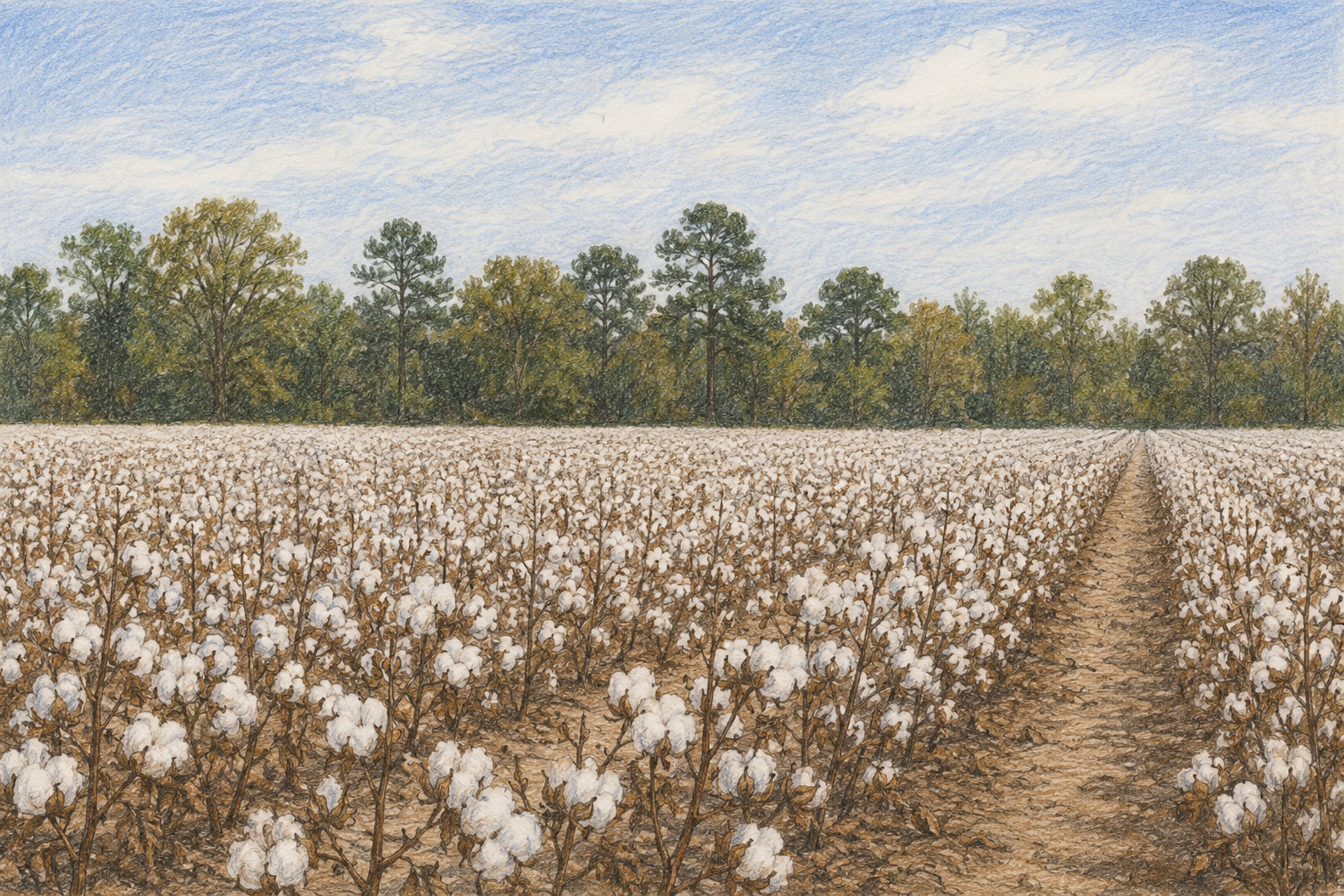
To be fair, the acreage has shifted around. While cities have grown, agriculture continues to decline. The year 1900 was the peak of 100 years of cotton farming in the state. “I wish I was in the land of cotton” used to be a real thing: six million acres of it were planted anywhere it could be planted (and some places it shouldn’t have). There are around 50,000 acres of cotton land today, and “old times here are quite forgotten.”
There’s a reason that cotton is gone. Many have learned just enough history to think it was due to the boll weevil, an insect which is commemorated by a statue in Enterprise (in case you ever want to make a pilgrimage). But the truth of cotton’s decline is much more complex. There were environmental, technological, labor, and political causes, but the biggest factor was that the global market for cotton changed. On the bright side, what was bad for cotton was good for trees, which grow well on lots of soils, even those worn out by continuous cotton cultivation.
I feel certain that if you could travel back to 1900 and tell an old-timer that there would be very few cotton fields in 100 years, he would have laughed you off his porch, because cotton was about all you could see in every direction.
That is the same thing someone would tell you today about Alabama’s abundant forest.
I am a professional forester. Or at least I was for about 35 years. Now I am retired, which I suppose has reduced me to amateur status. This happened much earlier than expected, and not by choice. A couple of diseases from a tick bite changed my life, both personally and professionally.
Forestry was a decent way to make a living. I did not get rich, but I am not poor by any means. I met a lot of interesting people and walked through some of the most beautiful places in Alabama. A lot of my time was spent in solitude, which allowed contemplation. But most of the work required a certain amount of haste. Nothing leisurely about it. Not enough time for a sincere appreciation of the sheer wonder of it all. I regret that.
Now that I have more time, a visit to the woods is a rare treat — and almost never made alone.
One thing that has always amazed me is how little people know about forests and forestry. Alabamians especially. The state is about 70% forested, and the associated forest products industry is the second largest in terms of economic activity. But the majority can’t see the forest for the trees.
The Redhead asked me to tell you a little about it, probably so I won’t keep telling her about it. I suspect it will be a long tale, a mixture of fact and opinion. Some parts will hopefully be interesting. Others, maybe not so much. Just skip the boring parts and jump back in later.
I will give you the ending here, at the beginning. The forest landscape is about to undergo an epic change in the South. It will not be caused by any natural disaster, insect, disease, or plague. It will be diminished by a forest product called pulpwood.
I wrote about Catherine and Buddy here several years ago. We were neighbors then, but the Redhead and I moved back to town shortly after I told you that little rose-colored glasses tale.
Over the last four years I have passed back and forth by their house many times. Last time I stopped was at the beginning of the pandemic. I dropped off a couple of N95 masks and told them to be careful if they went to town. Looked like there was going to be a bad virus going round, and they were saying it was going to be hard on old folks.
Since, one or both usually on the porch whenever I pass. They wave. I wave. Me always thinking I should stop and talk a minute, just check on them, but I never did. In a hurry. Felt too bad. Needed to get on home. Next time. Whatever excuse worked that day.
Shame passes quickly when you develop the knack. Still, I asked myself “What kind of person behaves this way?”
I never liked the answer. Still don’t.
Today Catherine is out by the mailbox. She flags me down, arms waving, as in ‘you need to stop, and you better stopnow.’
“Buddy wants to see you. He’s got some questions he wants to ask you. Go on up. I’ll be up directly.”
He sits on the glider, as always. I shake his hand and move to the guest chair, diagonal from him about four feet away.
“Good to see you,” he says. “How you been lately?” He always says that.
“Not so good. I’ve been sick since I got bit by a tick a while back and –”
“Huh?” he says.
I try again, but it is obvious that he can’t hear me. I look to the yard for help, but Catherine is still dawdling by the Knockout Rose, which is gorgeous this year. I cross the porch and reposition myself in her chair to be at his ear.
He continues. “You heard any turkeys gobbling this year?”
“No, I haven’t been down here at sunrise in a while. You know I can’t get around in the woods like I used to since I’ve been sick, so I didn’t go at all this year.”
“Huh?” he says. Didn’t hear a word of it.
“Used to be a lot of turkeys around here, but not no more. Last time I saw a turkey gobbler was four, maybe five years ago. I come to the door one morning and there was one standing at the far end of the yard. He was tall as my waist. Beard hanging down nearly ‘bout to the ground. He took off running right down the road towards your place. I heard a shot a little while later down in the bottom. I figure it was that Lewis fellow that lives down at the crossroads. You know he hunts all the time – don’t pay no attention whatsoever to whether the season’s in or not. I’ll bet that was the turkey I saw, ‘cause I ain’t seen him again since.”
“Probably,” I say. Add a nod for good measure.
“You ever seen things in as big a mess as we’re in? I tell you that Joe Biden is running this country in the ground.”
The next several minutes are a non-stop soliloquy about the mess we’re in. The war in Ukraine. The open borders. High prices for everything. The disappearing work ethic. It is animated and punctuated by profanity, the kind once reserved only for sailors like him.
I do a lot of nodding. The name “Trump” never comes up just in case you are wondering. It is not a rant about what could have been, or should be, or might still could be. It is about what is.
After a while he seems satisfied that he has said what he needed to say, and we both sit quietly. Catherine has finally come up and sits down in the guest seat. She looks back and forth, at him, at me, as if she is following a conversation between us, even though none is occurring.
We all just sit. Silence is acceptable porch etiquette in the South. Even expected. As much a part of the conversation as the words.
Buddy looks at neither of us. His gaze is straight ahead as if he might be watching that gobbler walk over the hill.
“You know, I worked down at the car dealership in town for 38 years. I was a good mechanic, could take any Chevrolet apart, car or truck, from bumper-to-bumper. Put it all in a pile then turn right around and put it all back together again. All them years I fixed the town people’s cars. When I left there they was paying me four dollars an hour. I woke up one day and said, ‘to hell with it.’ They don’t appreciate me no more than that they can get somebody else.
I heard the town was building a water treatment plant. I put in an application, and they offered me the job because they knew I could mechanic. I had to drive down to Montgomery for a while to go to a school to learn how to run it. Got a class three degree in wastewater treatment so I’d know how the thing was supposed to work.
I ran that plant for ten years. Just me. Whole time I was on call 24/7. If anything went sideways, I’d drive in and fix it, day or night. I didn’t make a bunch of money there either, but they bought me a pickup truck so I didn’t have to wear out mine driving back and forth.
Them State boys would come up and inspect everything regular, but they never did find nothing wrong. I got to be fairly good friends with one of them. He’d say “Buddy, how come you don’t keep several of everything you might need in the shop so you don’t have to go get a part when something breaks down?” I told him I didn’t see any point in that. If I needed a part or a tool I’d just get in the truck and go get it. Why spend money on keeping inventory in a room just sitting around? That’s foolish. Then he said, “why don’t you keep any tools in your truck?” I said why would I, everything thing I need to work with is right here. No point in carrying around a bunch of extra weight in a truck, burning gas and wearing it out. I got tools at home if I need them around my place.
I told them going in that I would work until 63, then I was going to retire. That’s what I did.
Thirty-eight years at the car place and ten at the treatment plant. I never made no real money, but we had enough to get by. We got our place here and everything’s paid for, don’t owe nobody any money. We get social security from the government and that covers what we need, as long as Joe Biden don’t take that away and give it to them people he’s letting into this county.
I worked all of them years. Never complained about low wages or getting up in the middle of the night cause some alarm went off at the plant. Never stole nothing, not so much as a wrench or even a bolt to use on something here at the house.”
A pause. He looked at me and then looked down. A single tear rolled down his cheek.
“What was it all for?”
He began to cry. Cry like when somebody tells you your momma’s dead. Great shuddering sobs. His voice became high-pitched and childlike. His words Faulkneresque, one long stream-of-consciousness sentence punctuated by little gasps between sobs. His hand at his lips, the way old folks subconsciously do when they’re afraid their false teeth might slip out.
Catherine gets up and stands by him, hand on his shoulder. She looks at me, expressionless.
“I’m 96 years old. I hurt all over all the time. My knees and elbows and back – every part of me. I can’t hardly walk so I don’t go nowhere anymore unless she takes me to the doctor, and that’s a wasted trip ‘cause they don’t do a damn thing except give me some other kind of pill to take. I can’t hear nothing. I can’t see nothing. I can’t eat nothing that tastes good cause they won’t let me have any salt. I can’t sleep no more, day or night, cause I’m always hurting so bad. All I do is sit here on this porch or inside the house, day after day, night after night. Why don’t I just die? I ought to just kill myself and be done with it.”
Ah, I think. The ghost of Christmas future.
“No,” I say. “Ain’t no good going to come from that.”
It’s all I can think of to say that I will say. I know I bit of Hebrew poetry written by The Preacher in Ecclesiastes 12 that describes this journey to the long home. But I won’t read it to him. Not today. Vanity of vanities.
He is done talking. His gaze is at the floor. The tears still roll, but he is regaining his composure.
Catherine begins to explain. I don’t know if he can hear her. Maybe, maybe not.
“He ain’t in too good a shape. He can’t hear it thunder, and the hearing aids I got him don’t work. He’s got a cataract on one eye, so he don’t see too well neither. He’s got arthritis and he has two cysts, one on each kidney. They doctor says they are both benign, but they make him hurt. That mesh they put in him when he had his hernias fixed has broke loose, so it moves around sometimes and that hurts him too. That’s why he has trouble sleeping. He can’t get comfortable. They won’t operate on him. Did you know they won’t operate on you once you reach 90?”
“Yes ma’am, I did know. Can’t they give him anything for pain? Anything to help him sleep?”
“Oh, they have, but it don’t work. He won’t eat much I fix him because they won’t let him have any salt in his food – they say sodium, but they are really talking about salt. You know food don’t have much flavor without salt. I can’t do much for him. He just sits around day and night watching TV or out here on the porch.”
“Hey Buddy,” I holler. “Listen, you don’t need to be sitting around all day watching Fox News. You can’t do anything about the shape this country is in, so quit listening to those people talking about it all the time. Find you something good to watch, like Andy Griffith or Gunsmoke. Find you a good old cowboy movie.”
“I don’t watch Fox News.”
“Yes he does,” she says. “Yes you do,” she hollers.
“I don’t,” he says again. He has regained his composure. Now Stoic.
We talk awhile longer, Catherine and me.
“What can I do for him? Could I bring him something sweet to eat?
“Oh, I fix him sweets. He just can’t eat salty things.”
I’m running out of ideas. I try one more.
“Buddy, how about I stop back by in a couple of days. I’ll bring my buggy and we will take a ride over to the back side. Maybe you can show me where your grandaddy’s mule barn was? You told me about it one time.”
“I’d like that,” he says.
I get up to go. We shake again. “Well, I have to get home now.”
“Stop again next time you pass.” He always says this.
What was it all for?
It’s the question we all must ask ourselves if we live long enough.
I have my beliefs, but The Book says beliefs aren’t worth anything without action.
I chew on that on the ride home.
Maybe the answer is as simple as stopping by to sit on a porch every now and then.
I got an email one morning just the other day that announced the upcoming North American Tour of the ‘70s rock band Heart. A stop in Birmingham later this year, and Ticketmaster thought I should know. I am not sure why. A YouTube video I clicked on, or some all-seeing/all-listening electronic entity noticed I always turn the volume up on my truck radio whenever “Barracuda” or “Dreamboat Annie” play.
I was intrigued. I clicked on the link to see what seats were available and how much.
Turned out two good ones at $130 per.
I almost got up to get my credit card, but I decided to mull it over until evening. The waiting was difficult because of a memory.
It was in ’79 or ’80. A brown-eyed boy asked a red-haired girl out on a date. One of the two in love – had been for quite some time. The other, not so much.
I got the friendship date. A few hours with her would be worth the cost.
It was, by the way, expensive. Eight dollars a piece on the seats. Probably ten to fill up the tank of the Camaro to drive to Birmingham and back. Another ten for dinner and concessions. All in, somewhere around $36.
You laugh and wish you were around in “the good old days.” But keep in mind that I only had a part-time-after-school-and-Saturday job. Minimum wage was $3.10. I had a solid 12 hours of sweat commitment to that girl. If that ain’t love, love never was.
My memory is that it was a great show. I did not win her heart that evening, but I recall a hug and a little peck on the cheek. Money well spent.
Back to the present day, forty some odd years later. I kept turning that sweet memory over in my mind as I drove down the road, the radio tuned to a “classic rock” station. “Barracuda” came on as if by magic. My mind made up. It had to be fate. I would pull the trigger on the tickets when I got home.
Then fate actually made an appearance. The DJ (what is the correct term for that vocation today, “streaming digital song selector?”) mentioned that Heart was about to launch a tour, and they had appeared on one of the late-night T.V. shows to kick things off. If I missed it, I could catch it on YouTube.
I did. Wow.
That sweet, amazing soprano voice was mostly gone. Her sister’s guitar work was adequate but labored. Frankly, I had heard better covers of the song. They looked and sounded so old. How could that be?
Because they are. So am I. I keep forgetting.
I passed on the tickets. Let Dreamboat Annie’s “little ship of dreams” sail on through Birmingham.
Besides, the investment paid off. I eventually got that Redhead to love me back.
You must be logged in to post a comment.