Woods No One Owned

“At one time in the world there were woods that no one owned,” wrote Cormac McCarthy in Child of God.

If you want to tell a story, start at the beginning. But there is a problem if your tale is about a forest. When exactly was the beginning?

I once attended a lecture on Alabama’s National Forests at which a government forester claimed that the U.S. Forest Service was enacting a management plan to restore public lands to their “original condition.” I raised my hand and asked when the forest was “original.” After a great deal of stuttering and stammering he admitted that what he really meant was before any logging.

That’s a beginning with which we can work. What did Alabama’s forest look like before anyone owned it – before logging?

My best guess is 1775, the year that naturalist William Bartram documented his travel through central and southern parts of the state. Bartram was a true “Renaissance man,” an explorer, botanist, artist, and writer, and his descriptions and drawings of plants and animals are the definitive narrative of the southern landscape before European settlement.

What Bartram described is something vastly different from what exists today.
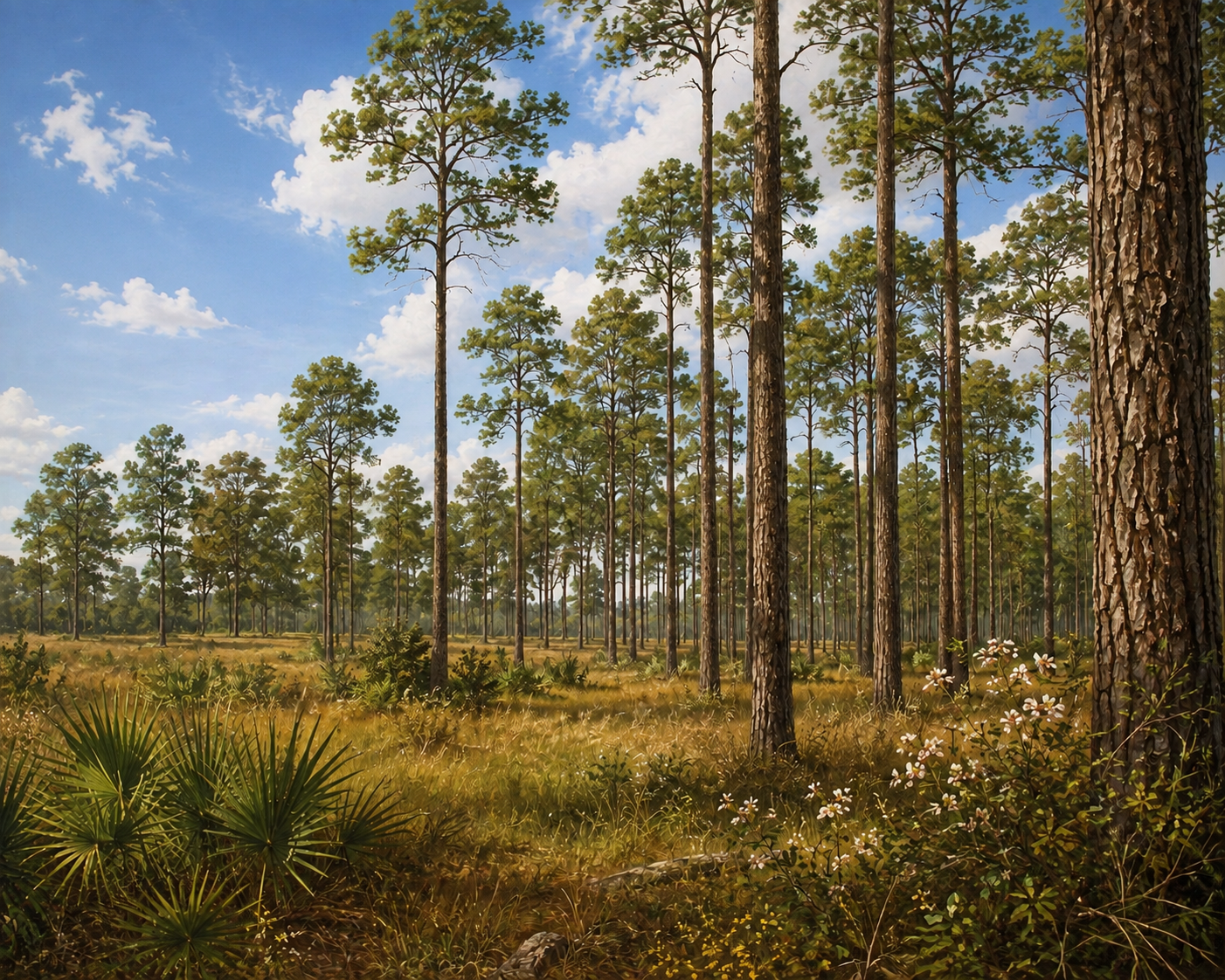
In what we now call the “Coastal Plain” he found longleaf pine savannas, vast areas occupied by “the stateliest pine trees that can be imagined.” This forest was open and prairie-like, with large, widely spaced trees “standing like columns or pillars,” and a ground cover of grasses, wildflowers, and shrubs. The openness of this forest allowed him to travel through on horseback. He accurately surmised that the longleaf ecosystem was maintained by frequent fires, which occurred both naturally and through intentional actions of the natives.

A reasonable estimate of the longleaf forest in Bartram’s time is 30 million acres. Today there are about three million, and much of that consists of young longleaf plantations. There is a lot of interest in restoring the ecosystem, and public and private agencies offer grants and other funding to encourage landowners to plant longleaf.

Along rivers and creeks, he found something entirely different. Great stands of massive hardwood trees including oak, ash, elm, baldcypress, sweetgum, and southern magnolia. Thick vines grew up into the canopy, and the groundcover consisted of ferns and lush vegetation. He described this forest as “cool, shady, and luxuriant.”

The bottomland forest in Bartram’s time is estimated to have covered six million acres. Today there is about 2.7 million, with most of that having been cut at least once.
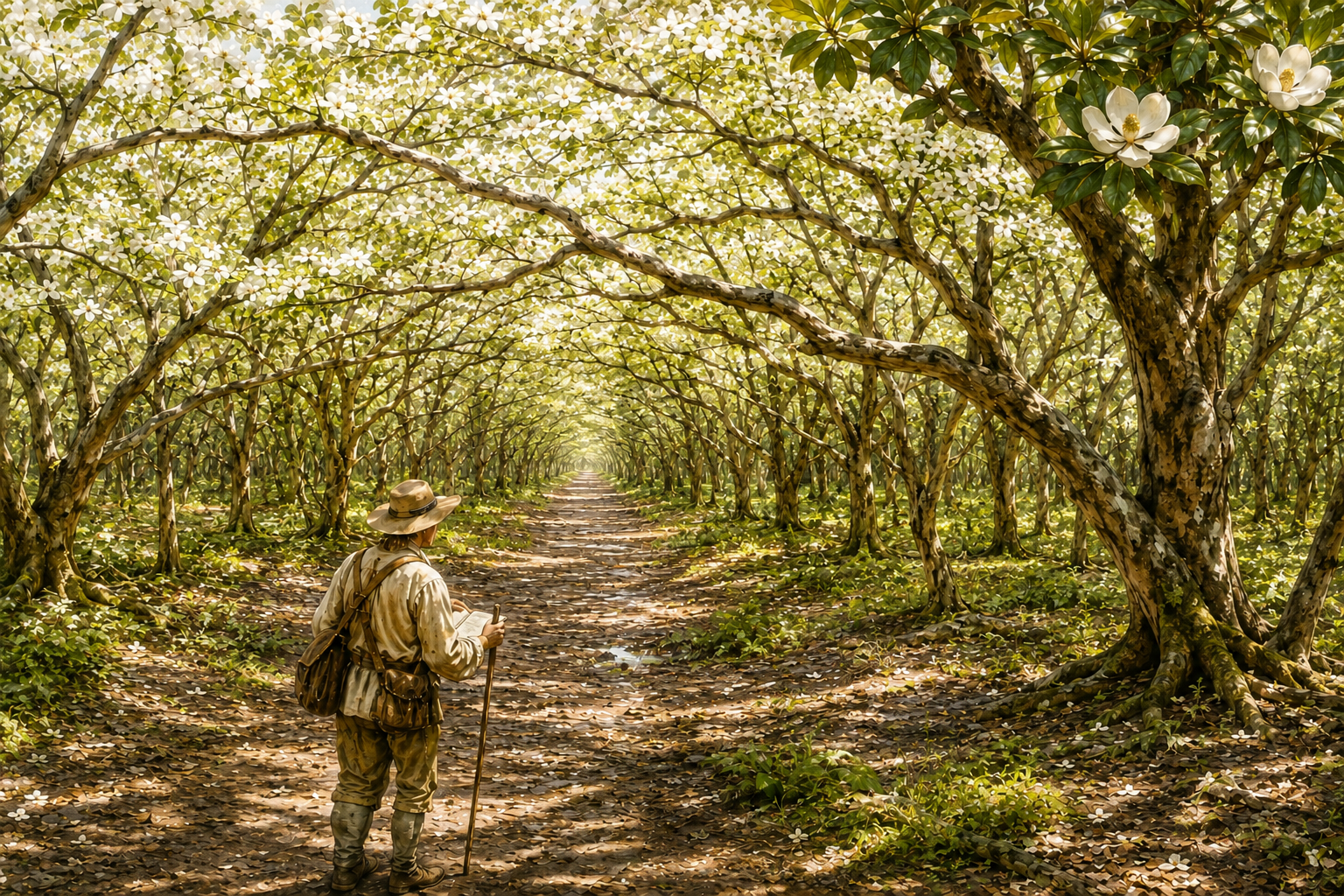
Just south of what is now Montgomery, Bartram described something foresters find puzzling – a nine-mile-long stretch of flowering dogwood trees so dense that it was a monoculture, punctuated occasionally by a southern magnolia. The curious thing about that is that dogwood today is found as individual trees scattered across the uplands. What he described does not exist today.

While Bartram did not travel through the hills and valleys of North Alabama, we can surmise what he might have seen from the writings from settlers in the early 1800s. Oak, hickory, American chestnut, hemlock, and various pine species covered this area. Most has since been cut and regenerated several times, and a substantial portion is now in pine plantations. American chestnut, which may have constituted 30% of this upland forest is extinct, killed by a blight over a couple of decades in the early 20th century.

The bottom line: the forests we have today are quite different than the “original.” The terms “virgin forest,” “virgin timber,” or “old-growth timber” simply do not apply in Alabama. Every forested acre that can be logged has been — several times. A tree over 130 years old is rare, and a group of trees that age standing together on an acreage large enough to be considered a forest is non-existent. There are a few exceptions, of course, but they are occupying land that is extremely hard to access – which is why they are still standing. These “patches” of forest exist in areas so steep, narrow, swampy, or rocky that no enterprising timber man ever figured out how to get in to cut them. We have lots of trees, but they are not as old as you might think. Next time I will tell you a little bit about how we got from Bartram’s “original” forest to that we have today.

Photos generated by AI
The State of Forests

Alabama has trees—so many that most of us who live here hardly notice them.

Auburn University recently hosted a World Cup Soccer “friendly” match between Argentina and Iceland that drew 88,000 fans. Subsequent social media posts from international visitors both amused and honored us. Visiting fans expected the arrogance of American Exceptionalism and gun-slinging violent crime—they said so themselves in numerous on-the-ground interviews. Instead, they found Alabama bursting with friendly, helpful people. They were overwhelmed and delighted with some of the trappings of Southern culture like Buc-ee’s, Waffle House, Ranch Dressing, and … trees.

“Oh, the trees. Everywhere there are trees!”

And that is true. Alabama is about 70% forested. That’s about 23 million acres of trees.

I don’t know about you, but a million of anything is hard for me to visualize. When it comes to land, I can visualize an acre as roughly the size of a football field (real football, not soccer). Twenty-three million football fields is a lot of ground.

The politics of the “green” movement will try to convince you that deforestation is a threat to the planet. It may well be a threat in some areas of the world, but not in Alabama. Would you believe the acreage of forestland here is the same as it was in the early 1900’s? That is astonishing considering the increases in urbanization and industry over these 126 years. Alabama had a population of 1.8 million in 1900, and now stands at 5.2 million, a substantial portion of which resides in a half-dozen cities.

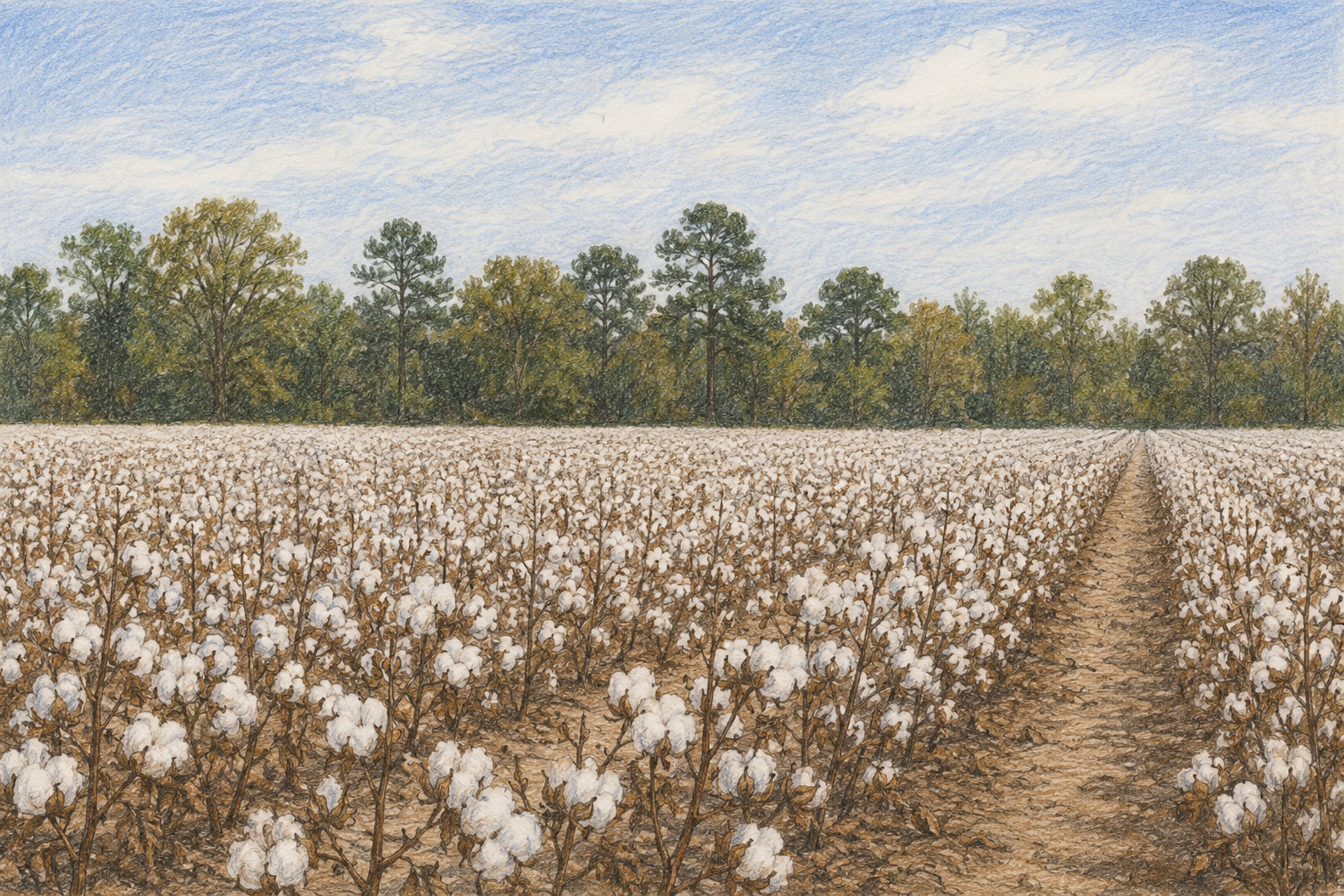
To be fair, the acreage has shifted around. While cities have grown, agriculture continues to decline. The year 1900 was the peak of 100 years of cotton farming in the state. “I wish I was in the land of cotton” used to be a real thing: six million acres of it were planted anywhere it could be planted (and some places it shouldn’t have). There are around 50,000 acres of cotton land today, and “old times here are quite forgotten.”

There’s a reason that cotton is gone. Many have learned just enough history to think it was due to the boll weevil, an insect which is commemorated by a statue in Enterprise (in case you ever want to make a pilgrimage). But the truth of cotton’s decline is much more complex. There were environmental, technological, labor, and political causes, but the biggest factor was that the global market for cotton changed. On the bright side, what was bad for cotton was good for trees, which grow well on lots of soils, even those worn out by continuous cotton cultivation.

I feel certain that if you could travel back to 1900 and tell an old-timer that there would be very few cotton fields in 100 years, he would have laughed you off his porch, because cotton was about all you could see in every direction.

That is the same thing someone would tell you today about Alabama’s abundant forest.

Unless he is paying attention.

“The Moving Finger Writes…*

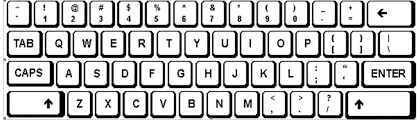
keyboard

In my previous post I mentioned that it takes hours to write one of these little stories.  That’s not exactly true.  It takes minutes to write a story but hours to edit it.  Editing is the real challenge of “trying to get the words right.”

But I confess I have another reason it takes me so long to write a story.  I can’t type.

I am embarrassed to admit that I am strictly a one finger hunt-and-peck man.  Occasionally my left index finger will get involved, but it usually doesn’t get past the “D.”

Then there’s that nasty business with the “Caps lock” key.

It’s not that I am ignorant or untrained.  I took a typing class in high school.  My friend Winfred and I were unfortunate enough to sit front and center in Mrs. Kidd’s little shop of horrors.  Winfred was a great defensive tackle who played some college ball and then went on to become a preacher.  He was my salvation at the time, because he was as bad a typist as I.

If I were a betting man, I’d wager old Winfred writes his sermons by hand.

Mrs. Kidd stood directly in front of us (actually, more like over us) as she gave instructions.  I don’t remember much about her except that she was rather stern and had big nostrils.  Added pressure there.  Ever try to concentrate while looking up at the business end of a double barrel twelve-gauge shotgun?  To make matters worse, she always carried a big wooden ruler, which she regularly applied to my hands when they were in the wrong position.

I went through that entire school year with bruised knuckles.  Told my daddy I got them at football practice.

Once a week we had the dreaded “words per minute” test.  On a good day I might manage 20, and five of those would be misspelled.  But those tests were really the only reprieve I ever got from the tyranny of Mrs. Kidd.   You couldn’t cheat front and center, but a scatterling of cheaters were behind me.

The test would go something like this: “Limber up your fingers.  Type what I’ve written on the board.  We’ll start on my mark in 30 seconds.”

Then, ever so faintly, I’d hear it.  Chick.  Chick.  Chick.  Mrs. Kidd heard it too.  It sent her charging to the rear like a rhino, ready to administer a little corporal punishment to someone else for a change.

I managed to make it through the year.  Think I made a “C” by the skin of my teeth.  But I never attempted to type again.

The other night I asked the Redhead if I was too old to learn to type.  She told me that there were plenty of internet sites that might help.  I looked at a few and thought “maybe I can still do this.”

Then I remembered what a college professor once told me.  “Research has shown that it takes about 10,000 hours to master a skill.”

If my math is right, that’s 417 days, nonstop.  If I subtract hours for leisure activities like work and sleep, I’d be looking at about five years.

That’s a big commitment.  The way I feel most mornings when I get out of bed, I’m just hoping I live another five years.

I think I’ll just stick with hunt-and-peck typing.  With the time I save I might be able to get that left finger nimble enough to reach the “F.”


*and having writ, moves on.”  Omar Khayyam.


The Encourager

I have an unpaid debt.  It is long overdue, and I am going to try and pay it now.

I started writing when I was a child.  Mostly scraps of poetry.  Truthfully, I was a little embarrassed by it.  I spent most of my youth trying to prove I was a “tough guy.”  Just hit home runs, strike batters out, and bust somebody’s head every now and then for good measure.  Writing didn’t fit the persona I was trying so hard to create, so I kept it to myself.  To paraphrase the late William Gay, “you don’t spend two hours at football practice trying to crack open someone’s skull, then come back into the locker room and say ‘Any of you guys want to hear the sonnet I wrote this weekend?’”

Being a writer wouldn’t put the fear in the boys and more importantly, it wouldn’t impress the girls.

Then one day I was exposed.

I was in a ninth grade English class when I first met a “real” writer.  He was our “Poet in Residence” for a few months.  I still don’t know how he got a gig like that.  Probably some sort of Federal Endowment to Enlighten the poor art-deprived kids in a little central Alabama town.

Now he was the image I had of a writer.  A kind of funny-looking little man dressed in jeans, flannel shirt, and one of those coats with the elbow patches.  He didn’t look like he’d ever been in a fight, unless of course someone had beaten him up.

He talked to our class about poetry, then asked us to write one.  In the next few minutes, I scratched one off.  I looked around.  Almost everyone else just sat staring at their blank piece of paper.

“Now who’s got something for me to read?”

One thing for certain, it wasn’t me.  Not only due to my secret, but also because my first line was “A short, funny-looking man in a flannel shirt asked me to write a poem about writing a poem.”

What I didn’t know was that the girl sitting behind me had been peeking over my shoulder.  She reached around me, snatched the paper off my desk and said ‘’Here’s one!”

I was mortified, but it was too late to stop it.

The poet came over.  He took it from her, read it to himself, and smiled.

“Listen.  This is just what I’ve been talking about.”

He read it.  I looked around.  The teacher was smiling.  A few of my classmates were smiling.  I think I might have even heard a “Hey, that’s pretty good.”

Now everybody knew my secret.  I felt like a circus freak.

But the thing was, I kind of liked it.  I had written something that somebody thought was pretty good.  That made me feel good.

Now I won’t say that girl completely changed the entire course of my life.  I didn’t go on to become the next Great American Writer.  You won’t find me in the bookstore, unless I’m browsing.  I wrote off and on over the years, but I still kept most of it to myself.

Then about ten years ago, I started writing this little blog.  It isn’t easy, because I am my own harshest critic.  I spend hours at it, but I am never completely satisfied with the result.  It could always be better.  It should be better.  A word more here – a word less there.  Why am I doing this?

But now and then I get a little note from that girl who sat behind me all those years ago.  It’s always something like “Hey, that was good.  I really enjoyed it.  Keep it up.”  Then that feeling I had in the ninth grade returns, and I sit down and try to do it again.  To do it better this time.

I’ve never repaid that debt to her, but I am now.

Thank you, Leslie. You are the one who gave me the courage to be a writer.  If it wasn’t for you way back then, no one would be reading this now.

You didn’t know?  Well now you do, and so does everyone else.

The Time in Between

sunrise 2

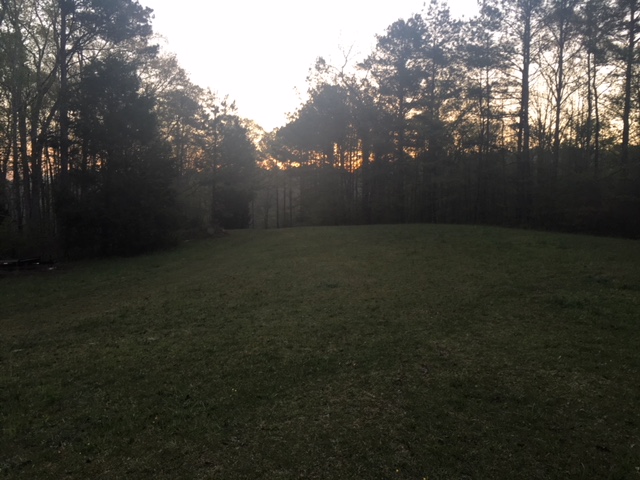
Sunrise at the homestead.  The best time of day.

I walk out on the back porch, as I do every day.  I am a daybreak riser.  My two bulldogs are not.  I get no acknowledgment.  Nary a lifted head.

I reckon some are just not morning people — or morning dogs, as it were.

I like to pause for a minute, even if it is just a minute.  A lot of years went by since I could appreciate this.  No man-made noise.  A turkey gobbles on the next ridge.  On a really good day, I can hear two more respond to his challenge.

I can’t stay long.  Miles to travel.  Things to get done.  Bills to be paid.

sunset

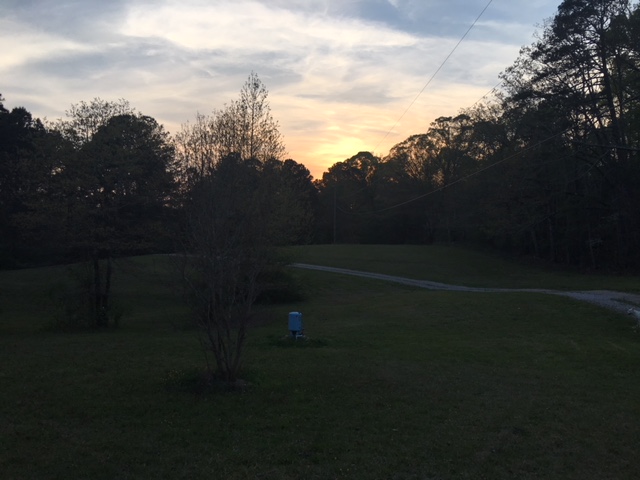
Sunset at the homestead.  The best time of day.

I walk to the back porch.  The bulldogs show their better nature.  The oldest moans like a broken-hearted man.  The other just smiles.  They know intuitively that they are going to get a jaunt down to the creek or get fed.  It is a win-win, either way.

This has been a long time coming.  Dark soon.  No man-made noise.  A coyote howls on the next ridge.  On a really good night, I can hear two more respond to the challenge.

As I write this, it occurs to me that it is the space in between these two times that kill a man.  They call it “stress” today.  In the olden times they just called it “livin’.”

A friend recently asked me if I had a “bucket list.”  I said I didn’t.  She looked at me as if I had shot her horse right out from under her.

Well why not for goodness sake?

Just don’t.  Never given it that much thought.

I think, though, that I may change my mind.

I think I would like to see the best time of day as many times as I can.