Woods Someone Owned

It took a little less than 80 years to transition from Bartram’s idyllic “original” forest, an unbroken landscape of “stately pines” and “lush bottomlands,” to a countryside that bore the marks of European colonial settlement. This change stemmed from a very American idea: that ordinary people could purchase land for themselves, work it with their own two hands, and build enough personal wealth to control their own destinies.

But before the land could be sold, it had to be controlled. Westward expansion into the 14 million acre “Mississippi Territory” followed the defeat of the British and the Creek Indian Nation in 1814. By 1819 Alabama had enough settlers to enter the Union as a state. By 1830 the native tribes were overcome and relocated to “Indian Territory” in present-day Oklahoma.

Back in Alabama, the territorial lands were surveyed into a rectangular grid established by the Government Land Survey System. This allowed land to be broken into parcels or lots which were offered by grant or sale to homesteaders at Government Land Offices.

Under private ownership, the towering longleaf pines and the lush hardwood river bottoms were more often seen as an obstacle than a blessing. Before a farm could be established, trees had to be cut and removed to prepare for homes and crops, and that was no easy task.

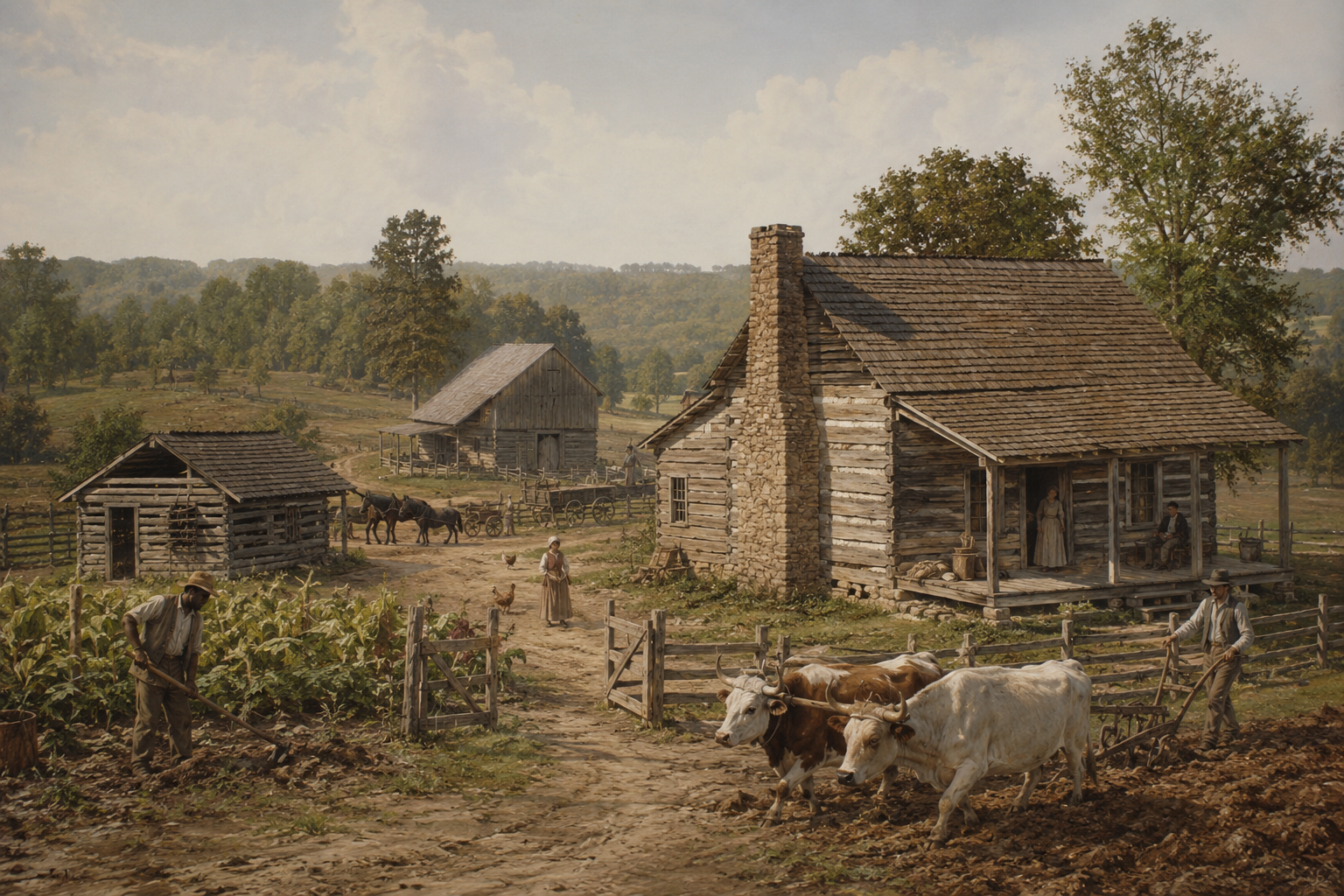
A typical homesteader cleared enough trees to build a small cabin and a few outbuildings, as well as clearing areas to grow crops. This was difficult, backbreaking labor. Trees were felled with axes and crosscut saws–called “misery whips” by settlers–and dragged to building sites by oxen, horses, or mules. The clearing and building process was gradual and often took place over several years. Once cleared, settlers planted corn, wheat, and vegetables and sometimes established fruit orchards. Rail fences were made from longleaf pine (or chestnut in the north) to keep free-range livestock out of the crops. The settlers initially relied on wild game as their meat source but soon hogs became the primary source of meat since pork could be preserved by smoking or salting. Once a few families had settled in an area, small communities developed.

The notion that Alabama was dominated by big cotton plantations and slave labor is false. The plantations were mostly prevalent in Alabama’s Black Belt Prairie (where there were few trees) and along major rivers. However, even small homestead farms eventually began producing some cotton by the 1820s. Cotton was a cash crop, and cash was scarce for subsistence farmers. Even though more land was cleared for cotton, the overall effect on the “original forest” was marginal.

Up until the Civil War, few areas of Alabama had anything resembling a large-scale forest products industry. Small sawmills were scattered across the state, usually along major creeks or rivers, but these did not become transformative until after the War. The same small scale held true for other commercial enterprises such as charcoal, turpentine, and crossties for the burgeoning railroad business.

After the Civil War, however, a new era would begin. The forest of Alabama was about to be transformed into a landscape that Bartram could not have imagined.
Woods No One Owned

“At one time in the world there were woods that no one owned,” wrote Cormac McCarthy in Child of God.

If you want to tell a story, start at the beginning. But there is a problem if your tale is about a forest. When exactly was the beginning?

I once attended a lecture on Alabama’s National Forests at which a government forester claimed that the U.S. Forest Service was enacting a management plan to restore public lands to their “original condition.” I raised my hand and asked when the forest was “original.” After a great deal of stuttering and stammering he admitted that what he really meant was before any logging.

That’s a beginning with which we can work. What did Alabama’s forest look like before anyone owned it – before logging?

My best guess is 1775, the year that naturalist William Bartram documented his travel through central and southern parts of the state. Bartram was a true “Renaissance man,” an explorer, botanist, artist, and writer, and his descriptions and drawings of plants and animals are the definitive narrative of the southern landscape before European settlement.

What Bartram described is something vastly different from what exists today.

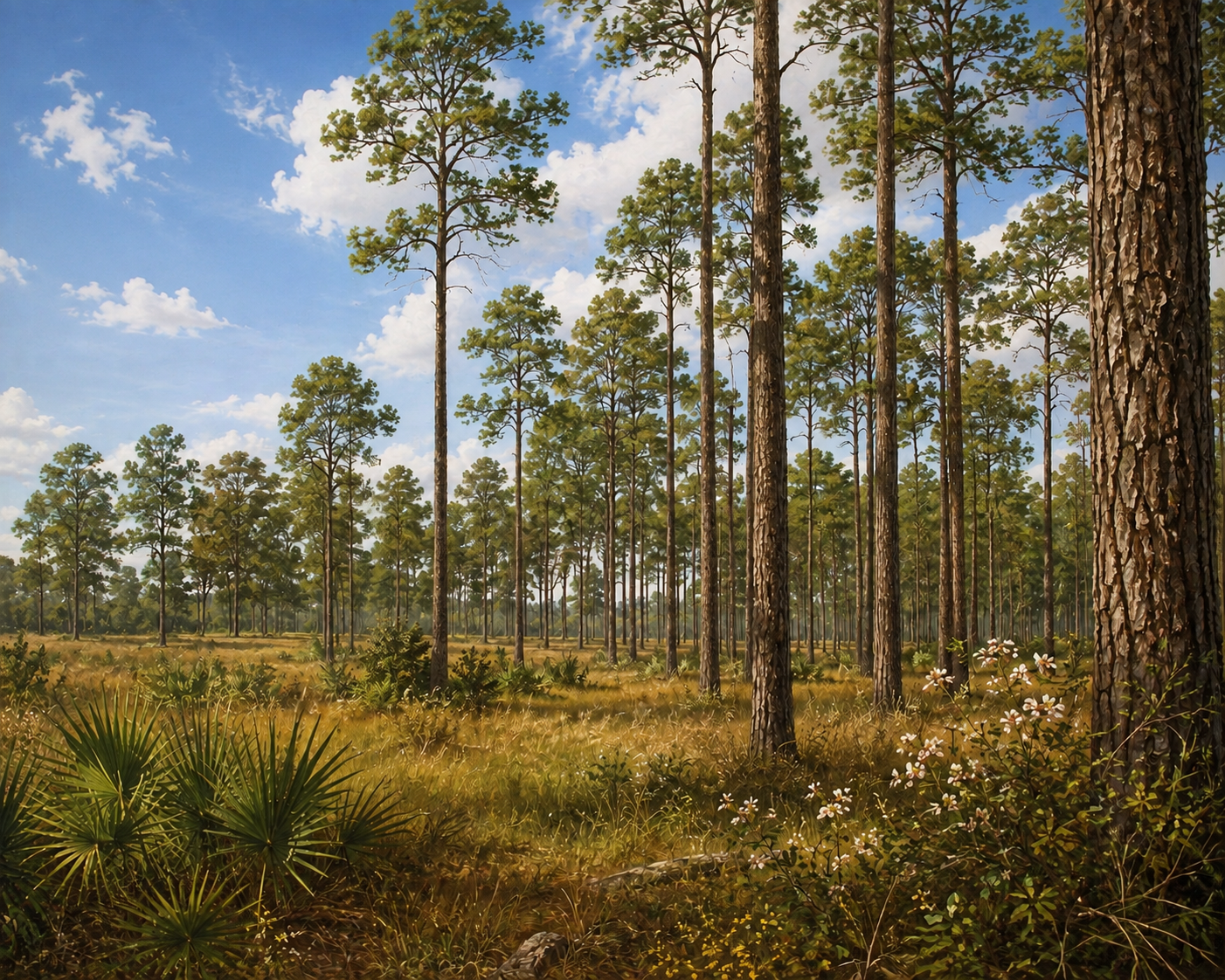
In what we now call the “Coastal Plain” he found longleaf pine savannas, vast areas occupied by “the stateliest pine trees that can be imagined.” This forest was open and prairie-like, with large, widely spaced trees “standing like columns or pillars,” and a ground cover of grasses, wildflowers, and shrubs. The openness of this forest allowed him to travel through on horseback. He accurately surmised that the longleaf ecosystem was maintained by frequent fires, which occurred both naturally and through intentional actions of the natives.

A reasonable estimate of the longleaf forest in Bartram’s time is 30 million acres. Today there are about three million, and much of that consists of young longleaf plantations. There is a lot of interest in restoring the ecosystem, and public and private agencies offer grants and other funding to encourage landowners to plant longleaf.

Along rivers and creeks, he found something entirely different. Great stands of massive hardwood trees including oak, ash, elm, baldcypress, sweetgum, and southern magnolia. Thick vines grew up into the canopy, and the groundcover consisted of ferns and lush vegetation. He described this forest as “cool, shady, and luxuriant.”

The bottomland forest in Bartram’s time is estimated to have covered six million acres. Today there is about 2.7 million, with most of that having been cut at least once.

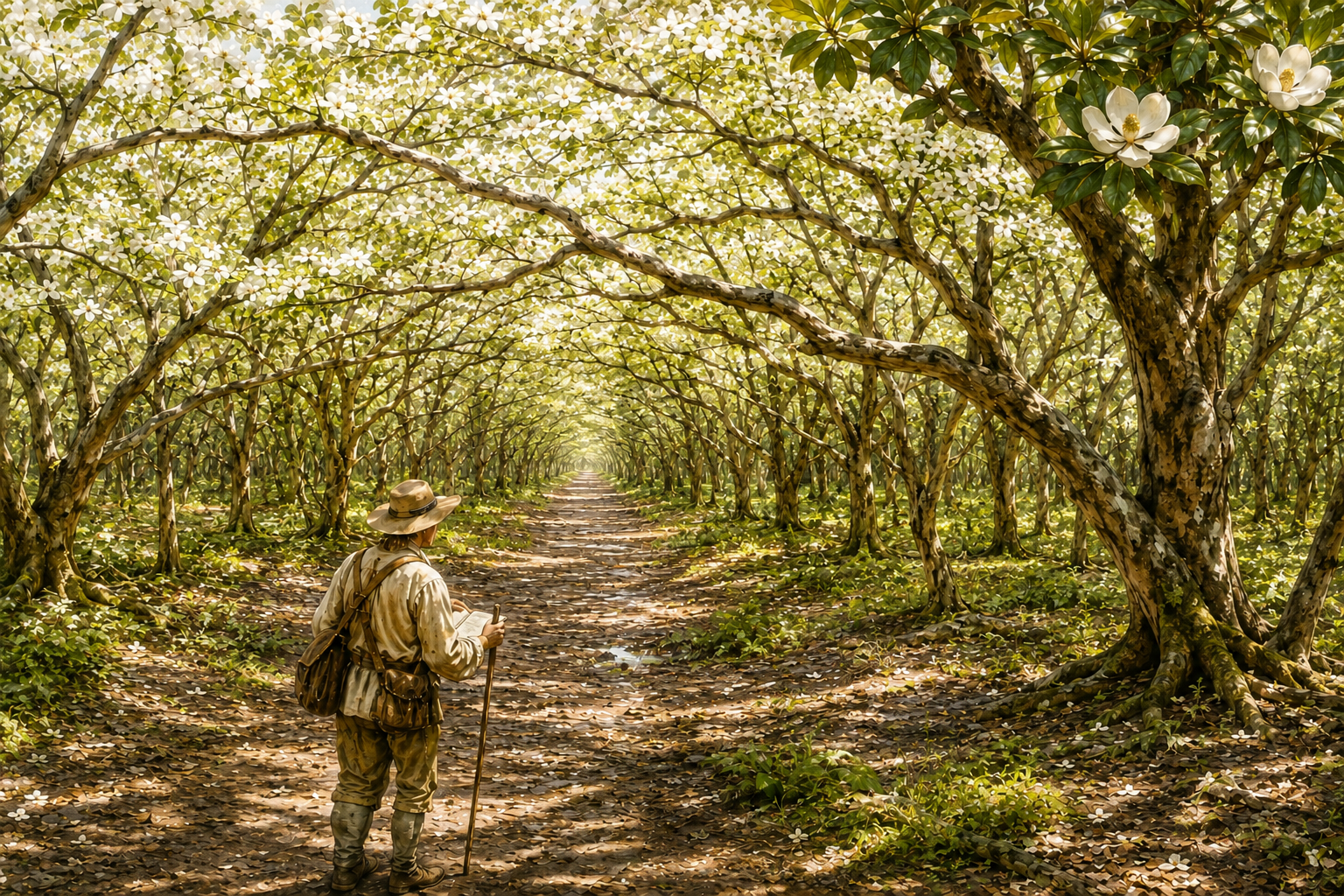
Just south of what is now Montgomery, Bartram described something foresters find puzzling – a nine-mile-long stretch of flowering dogwood trees so dense that it was a monoculture, punctuated occasionally by a southern magnolia. The curious thing about that is that dogwood today is found as individual trees scattered across the uplands. What he described does not exist today.

While Bartram did not travel through the hills and valleys of North Alabama, we can surmise what he might have seen from the writings from settlers in the early 1800s. Oak, hickory, American chestnut, hemlock, and various pine species covered this area. Most has since been cut and regenerated several times, and a substantial portion is now in pine plantations. American chestnut, which may have constituted 30% of this upland forest is extinct, killed by a blight over a couple of decades in the early 20th century.

The bottom line: the forests we have today are quite different than the “original.” The terms “virgin forest,” “virgin timber,” or “old-growth timber” simply do not apply in Alabama. Every forested acre that can be logged has been — several times. A tree over 130 years old is rare, and a group of trees that age standing together on an acreage large enough to be considered a forest is non-existent. There are a few exceptions, of course, but they are occupying land that is extremely hard to access – which is why they are still standing. These “patches” of forest exist in areas so steep, narrow, swampy, or rocky that no enterprising timber man ever figured out how to get in to cut them. We have lots of trees, but they are not as old as you might think. Next time I will tell you a little bit about how we got from Bartram’s “original” forest to that we have today.

Photos generated by AI

Eight: Southern Hospitality

I had lofty expectations for Emory.

I thought a medical school and research hospital must surely be the kind of place where collaboration and innovation were commonplace. I imagined doctors and professors in the cafeteria having coffee and discussing their days. One doctor would say, “I had this unusual case yesterday. The patient was bit by a tick and now he has forgotten how to walk,” and another doctor would say, “Wait a minute, I read about a case like that in Zimbabwe in 2011. We may have Patient Zero! Get him back in here. I will list you as co-author on the article I will write for Neurology Today.

My experience was only a little like that.

The first neurologist I saw was an attractive middle-aged Columbian woman who spoke the King’s in the manner of someone who learned the language classically rather than through Rosetta Stone. She spent an hour with me going through The Book, asking questions about this test or that. She and the Redhead discussed anomalies and their pertinence to a diagnosis.  

She spent a lot of time looking at the Electromyography (EMG) test results. She checked my reflexes with a small rubber hammer and an instrument that looked like a tuning fork and stuck me with a needle at various points on my feet and hands.

“Do you feel this? This? How about now?”

She looked thoughtful for a moment. “You have ‘glove and boot’ neuropathy. It is not the classic manifestation of carpal or tarsal tunnel. The nerves are not conducting above the typical compression points. This EMG report and diagnosis is not altogether accurate.”

We went down the “cause” list as I had done with all the others. No diabetes, alcoholism, heavy metals, pesticide exposure or family history of autoimmune disease?

I asked if it could be Lyme Disease, since all my symptoms originated after hospitalization.

“Neurological Lyme Disease is very rare in Georgia.”

I let it go.

I asked if I was going to get worse.

“It is difficult to say. I am going to refer you to one of my colleagues who specializes in neuro-muscular medicine. She will want to repeat your EMG and run some additional blood tests to make a diagnosis.”

We returned two weeks later.

This doctor was a young Ecuadorian. She brought along another young resident doctor, and we spent well over an hour rehashing my history.

She asked some questions that none of the other doctors had.

“Do you have dry mouth?”

Yes.

“Digestive issues?”

Yes.

“Do you perspire normally?”

No, I meant to mention that. I have always been a heavy sweater, but now I never break a sweat, even during a hard workout at the gym or being outside.

She and the resident exchanged glances.

“Interesting.”

We ran down the list of causes of neuropathy again.

She sighed. “Sir, you need to understand that 20-30% of all cases of peripheral neuropathy are idiopathic. Do you know what this word means?”

I said I was fairly sure that it meant the doctor either was not clever or caring enough to figure out a diagnosis. That was why I was at Emory, and why I was so happy that she was my doctor.

I think she smiled behind that Covid mask. At least her eyes smiled.

“I am going to run some extremely specific blood tests, including a genetic profile that may reveal a few rare mutations that can cause symptoms like yours. We will repeat the EMG test when you come back to see if there has been any progression in damage to the nerve function.”

She walked us to the front and told the receptionist to make me an appointment in two weeks. She patted my shoulder and winked. “See you again soon.”

I was hopeful. She was the one. We would only have to wait two more weeks to finally get the answer.

I did not realize that it would be the longest two weeks of the two-year ordeal.

Part Three: Stormfront

The following Monday I made the weekly hour’s drive to my employer’s headquarters for staff meeting and consultation with my coworkers. At that time, most of us were working from home, so Mondays were a chance to talk to a body in a body, even if was technically supposed to be from a “safe” distance. That had value for me. “ZOOM” was the name of a children’s program on Public Television when I was a kid. I wish it had stayed that way.

On the drive home I started to feel a little “off,” like I was coming down with something. Sluggish. A little feverish. You may recall from the previous post that this was June 2021, and COVID was beginning to make another run in Alabama. I imagine that anyone who had as much as a sniffle during those two years had the same thoughts that first went through my mind. What gatherings have I been to in the last week or so? Did that lady who sat beside me at church yesterday cough?

I took my temperature when I got home – 99.1.  Yes, I was getting sick.

I took a hot bath. As I toweled-off I made the discovery – an attached blacklegged (deer) tick. It was engouraged, so I knew that it had been there a while. I thought back. Must have been Saturday. I pulled it off and flushed it down the toilet.

Now, dear reader, I realize that you might not be the outdoors type. Perhaps you have never been bitten by a tick, and the whole idea that I could have acted in such a matter-of-fact manner seems incredulous.  But please remember that I am a forester. I had repeated that same process hundreds of times over the years. For those who work in the woods it is routine. Just an annoyance. Cost of doing business.

Tuesday morning. I felt worse. My head hurt a little and I was beginning to feel achy all over. So, I did what most folks do these days. Took my business down to one of the local “doc-in-a-box” franchises. There was a time when you could call your family doctor (now called your “Primary Care Physician”), but those days are gone. To do so now means two to four weeks unless there is a cancellation.

The routine at the corporate franchise is always the same.

“Have you been here before?”

Yes.

“What?”

I pulled my mask down to be heard. YES.

“Sir, please keep your mask on at all times. I will need you to fill out these six pages of medical history and consent forms. Sign or initial as indicated.”

But I did that last time I was here.

“We have updated our computer system. Oh, and I will need to make a copy of your driver’s license and insurance card. Also, your credit card for the copay.”

Thirty minutes later I made it behind the door to get my vitals checked and get the obligatory COVID test.

“You have a slight fever.”

Yes, that is why I am here.

“Go down to Room 2, second door on the right. The doctor will be in with you shortly.”

Several minutes later he entered.

“Good news, you do not have COVID. So, what brings you in to see us today?”

I have a slight fever and I do not feel well.

“Ah. Seasonal allergies. We have been seeing a lot of that these last couple of weeks.”

But I have not sneezed, coughed, or had as much as a sniffle.

“Well, that is probably coming. We caught it early. Stop by CVS and pick up some Mucinex D when you leave. I will have the nurse give you a steroid shot.”

Doc, I am sure this is not an allergy.

“Tell you what. We will draw some blood and see if everything looks okay. I will have the nurse call you back in if not. But I am quite sure you will feel better by tomorrow.”

I did not feel better tomorrow. I felt worse. Head and body. Like I was in the initial stages of the flu, but I still had no respiratory symptoms. My fever had crept to 100.

Wednesday, I went back. Same doctor.

“What brings you in to see us today?”

I saw you on Monday, remember? I have a fever and my headache is worse. My whole body aches.

“The steroid shot and the Mucinex didn’t seem to help?”

No. What about the bloodwork?

“Did we draw some blood? Let me check on that.”

A few minutes later he returned.

“You do have some elevated numbers here. Looks like you have some sort of infection. I am going to start you on a seven-day course of a broad-spectrum antibiotic.”

Doc, I do not know if this is relevant, but I should mention that I was bitten by a tick last weekend.

“I do not think so. Tick diseases are rare in Alabama. At your age it is more likely prostatitis. Go home and get some rest. Give the meds some time to work.”

Sunday, June 13. I go back again. My fever is holding at 100.5 and my headache is severe. Shut the door, close the curtains, turn out the light and get in bed migraine severe.

I got the same doctor. He ordered a chest X-ray.

I go back home and tell the Redhead that she needs to take me to the emergency room.

It will be one of the last things I remember over the course of the week ahead.