Moonstruck

moonstruck

A friend of mine wrote a short piece about a Parhelion, which I had never heard of.  You should read it here.

In our subsequent email conversation about the phenomenon, she wrote that she was surprised that her local newspaper didn’t have a photo.

I’m not.

I’d wager that nobody down at the paper saw it.

I don’t think anyone looks at the sky much anymore.  They’re too busy looking at their phone.

Not too long ago, I had a conversation with a thirtysomething man out on a timber yard.  I happened to notice that a full moon was rising.

“Look at that,” I said.  “It is going to be bright tonight.  My dogs will bark all night if I don’t put them up.”

“Wow,” he said.  “I didn’t know you could see the moon in the daytime.”

I didn’t know what to make of that.  Still don’t.

We weren’t in New York or L.A.  This is Alabama, where we still have plenty of sky to go ’round.  This young man is well-educated and spends a lot of his working life outdoors.

Apparently he doesn’t look up much.

A lot of people think we are living in the greatest time in history.  I reckon there is some truth in that notion.  Technology has information at our fingertips, 24/7.

Still, I can’t help but wonder where things are headed when people stop looking at the sky.

The Library on Main

library

I travel some, mostly to small-town Alabama.  Whenever I’m early for an appointment, I get off the bypass and head for the old downtown.  I like to park the pick-up and walk, get a feel for what was 50 or 60 years ago.

The bypass is what is across the South.  Big Box and fast food.  Chain stores and strip malls.  The New South, born in the late ‘60’s and early ‘70’s, when the state government and highway department decided that the modern traveler should not be forced to slow down to pass through the narrow streets and traffic lights that were the downtown.

Character and charm were the first casualties.  In modern Alabama you could head south from Huntsville to Mobile, fall asleep in the passenger seat and wake up three hours later in Anytown, Alabama.  Your first question will be “Where are we?”

Little towns across Alabama were built along the railroads.  The depot was the focal-point, where farmers brought beeves and produce.  Bailed cotton and yellow pine boards were loaded onto rail cars and shipped to the big city.  The shops on Main Street were just down from the depot.  Small stores where town folk bought everything they needed.  Feed store and mercantile.  Dress shop and apothecary.  Restaurant and Five-and-Dime.  Movie theater and gas station.

All gone now.  Shops require shoppers.  Shoppers require money.  Money requires good jobs.  Good jobs require that someone produce something.

Production jobs — the sawmill, the cotton mill, the garment factory, the small farm.  Closed-up and moved-on.  Now big corporations and banks run the economy, and what’s left is on the bypass, the “service sector,” where people flip the burgers, man the counters and stock the shelves.  Unload the trucks that transport the goods that the railroad once moved.

Still, all across the state there are attempts to bring back a semblance of what was, to re-vitalize the old downtown.  Main is repaved with brick or cobblestone.  Sidewalks are refurbished.  Decorative light posts and flower beds line the narrow streets.

Banks are eager to lend to a few local investors, those with just enough money to start and a dream of owning their own business.  It’s a win-win for the bank.  Collect interest on the loans, then call the note when revenue can’t cover the payments.  Do this again and again, as long as there are dreamers to be found.

The little Main Street I last walked is no different from a lot of the others.  Mostly empty storefronts with new facades.

I stopped at the “Southern Grounds Coffee Shop,” a tastefully decorated establishment that was empty, save me and the nice young man behind the counter.  Southern Grounds  offered all the brews you can buy in the chain store:  lattes, frappuccinos and expressos.  Flavored concoctions and iced-things about which I hadn’t a clue.  I ordered a simple cup of black coffee and was directed to a pot on a counter at the side of the store.  “Medium Roast” was all they had that day.  Good enough for me.

A few other stores down the sidewalk.  “Robyn’s,” where you can get your hair styled, and two clothing stores, one up-scale, the other consignment.  Both have names ending in “Kloset,” an indication that one lady-investor is both trendy and “all-in” on revitalization.

I began to feel discouraged about the future success of the project when I stumbled across an empty lot with something that looked like an over-sized bird house on a post.  It had a glass front and a hand-lettered sign that read “Borrow-Read-Return-Donate.  Future site of the Thomasville Public Library.”

There were 15 or so books, most unremarkable, but I noticed a paperback copy of Buffalo Gals, a Larry McMurty novel based on the life of Calamity Jane.  It’s no The Last Picture Show or Lonesome Dove, but it is a good read from a man who I consider to be one of America’s best writers.

I was suddenly struck by the irony.  McMurtry’s novels are often set in dying small towns, and his son James (a very good folk-singer) has a lot to say on that subject too.

But there was also this:  Larry McMurty’s personal library contains an estimated 28,000 books.  Someone once asked James about his childhood home and he reportedly said “It was like growing up in a damn library.”

The book is a talisman for this Main Street.  It shall be.  It must be.

Years from now, if I manage to stay on this side of the grass, I’ll come back to this town.  Park the truck and walk down crowded sidewalks.  Look through glass storefronts at happy customers with pockets full of cash money just itching to be spent.  Then I’ll head over to the library and amble through aisle after aisle of book-lined shelves.

I’ll be looking for one book — a weathered, dog-eared copy of Buffalo Gals.

This Little Light of Mine

flashlight

Let’s just say I’m lacking.

My dad could fix almost anything mechanical.  His degree came from the School of Necessity, a university a lot of men attended in the mid-20th century South.  We were not poor by standards then or now, but there wasn’t a lot of cash lying around to spend on things like eating out or buying new cars.  I think dad only had one new vehicle, a Chevy pickup that he managed to keep running for the last 15 years of his too-short life.

Some traits are genetic.  Mechanical ability apparently is not.  Or perhaps it just skips a generation every now and then.  I am mechanically-challenged.  My youngest son is not.  He simply clicks-up YouTube, watches a couple of videos, then proceeds to do things like rebuild the front end of a wrecked motorcycle he bought at a good price.

I watch the videos too.  All they do for me is remind me that I am a mechanical doofus.

It’s not that I didn’t have my chances to learn.  My dad worked on that aforementioned  pickup almost as frequently as he stopped to put gas in it.  I remember replaced starters, water pumps, radiators — even a transmission.  I was the assistant for all these repairs, but I didn’t learn the skills to actually do them.

I was standing right there.  But my mind was not.  It was always somewhere else, like on that girl in seventh grade homeroom, the skinny one with the big brown eyes and the double railroad track braces.

I did develop a specialty, however, one that I am skillful at even today.  It’s called “HOLD THE LIGHT OVER HERE.”

I don’t know why that old pickup had a tendency to break down in darkness, or maybe we just didn’t get finished before sunset.  But dad was going to finish.  Not finishing meant not having a way to get to work the next day.  Not working meant not getting paid.  Not getting paid meant not — well, you get the picture.

My skill at “HOLD THAT LIGHT OVER HERE” was developed through a rigorous training system that usually went something like this:

“Hold that light over here on the bolt.”

“Yes, April, I would like to hold your hand.”

“What?”

“Uh, um, yessir.”

“No son, on the bolt, not on my hand.  I can see my hand.  Shine it on the bolt.”

“Yessir.”

“On the bolt, son.  HOLD THAT LIGHT OVER HERE.”

It took years to master.

A few nights ago the Redhead called me from a gas station.  “I just filled-up, and now it won’t start.  All the indicator lights are flashing on the dashboard, but it won’t turn over.  Not even a click.”

“Ah,” I said.  “The battery is dead.  I’ll grab some tools and a flashlight and be there in a few.”

Fortunately, there was an Advance Auto Parts right across the highway.  I managed to get the battery out.  Ran over and bought the replacement.  Dropped it right back in.  But the cables would not fully-tighten on the posts.

“This must be the wrong battery,” I said.  “They’re on well enough to get us over to the store.  Follow me.”

There was no look of skepticism or disappointment.  The Redhead knows my limitations.

Parts Guy immediately diagnosed the problem.  “These new batteries are made so that the cables won’t fit tight on the terminals.  You need sleeves.  We have those.  Let me grab a set and I’ll help you hook it up.”

No, I did not ask why he didn’t sell me the sleeves when he sold me the battery.  But I sure thought it.

Parts Guy had trouble with the installation too.  After twenty minutes of wriggling, cussing and finagling he finally got that battery installed properly.  I just stood there, flashlight in hand.

Not once did he say “HOLD THAT LIGHT OVER HERE.”

I told you I had skills.


Author’s note:  This is not a Christmas story per se, as you might have expected.  But in a way it is, at least in a metaphorical sense.

A lot of people will have difficulty seeing the light today in a sea of darkness.

If you have the light, try to shine it in some way that may help them see it too.

Sleigh Ride

sled

I no longer listen.

As the years pass, Christmas songs have simply lost their magic.  I am a grown man.  My sons are grown.  If it were not for the grandbabies, I would have little motivation to do anything on Christmas Day other than say a simple prayer of gratitude, which I plan to do anyway.

Note that I did not say Christmas carols, which are a different subject altogether.  My favorite is Sweet Little Jesus Boy, a negro spiritual written in the ’30’s by the late Robert MacGimsey, a white man from Mississippi.  I suppose he and I are some sort of racists in today’s America.  I contend we both know a good carol when we hear (or write) one.

A couple of weeks ago the Redhead and I went to church to hear the dreaded “Christmas Musical.”  She sings in the choir, so I sort of had to go.  Men with wives, red-haired or otherwise, understand the “had to” part in the last sentence.  “At least I will get to hear some of the old carols,” I thought.  “Maybe they will get me in the Christmas spirit.”

Imagine my surprise when the choir opened with “Sleigh Ride.”  You know the one.  “It’s lovely weather for a sleigh ride together with you.”

And there you have it.  That is why I no longer listen to those old Christmas songs.  They are outright lies for someone who lives in the deep South.

I am from a small town in central Alabama.  When I was a kid, there was a Western Auto  downtown on Broadway.  I went there a lot with my dad because it was an auto parts store, something he needed frequently back in the day when you had to fix your own car. And trust me, dad spent a lot of time fixing.

Western Auto was more than today’s auto parts store.  Between walls covered with hoses, belts, and batteries were shelves lined with things that kept a boy occupied while his dad and a greasy guy looked for a water pump for a ’63 Rambler.  Bicycles (Western Flyer was the store-brand, a forgotten piece of Americana), sporting goods (from the Red Ryder BB gun to the more tempting Revelation 20-gauge single-shot shotgun) and other merchandise made a boy yearn for that glorious “some day, when you’re all grown-up.”

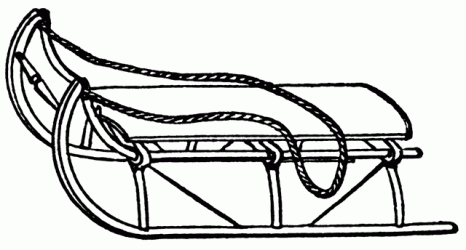
But the one thing that got my complete attention, every year just before Christmas, was the Flexible Flyer sled that sat on the top shelf in the center aisle at the very front of the store.  I would stand there, transfixed, hoping that Santa Claus might see fit to leave it under our lop-sided red cedar Christmas tree.  I dreamed of dashing through the snow, bells jingling, while my mom and dad went walking through a winter wonderland on that white Christmas.

Every year I asked my dad for that sled.  Every year he said “No.”

Finally one year, exasperated, he stated the obvious.  “Son, it don’t snow here.”

Seems like I would have figured that out in eight or nine years of living, but my childish hopes were still anchored in those lying Christmas songs.  Alabama Christmas is not white.  It may be gray, which I suppose sort of approaches white, but any precipitation is drop and not flake.

And yet even here the lies continue.  Some time back three ol’ boys from north Alabama made a pile of money with the song “Christmas in Dixie.”  It goes “Christmas in Dixie, it’s snowing in the pines…”

Liars.  I will not listen to your propaganda.  There won’t be any snow here on Christmas Day.  Not this year.  Not ever.

Still, after all these years I have to wonder.

Did any kid’s daddy ever buy that sled?

Funeral for A Friend

smooth stones

The Irish call it a wake.  People in Alabama call it visitation.

It is a ceremony for the living, held in the presence of the dead.  A family stands like deer in the headlights as others shuffle by, hands extended, hugs offered.  A surreal numbness.  Asleep and awake.  Time pauses, hesitates, hovers like a feather on an imperceptible breeze.

It is early and the line is long.  I expected that.  He was well-known and well-liked.  I take my place behind a friend, a friend of this friend.  We swap stories between starts and stops.  Stories are the life, after all.  Tales true and untrue, embellished or plumbed on the mark.  They keep the memory for as long as they are told.  Longer if someone takes the time to write them down.  A life is brief.  Words are the substance of eternity.

I turn over the words in my mind as we approach.  Lift them like smooth stones from the creek bottom.  Feel their heft.  Discard some.  Put a few good ones in my pocket.  Keep one or two of the very best in my hand.

First, the wife.  A natural Southern beauty who has lost a partner she has loved since high school.  Built a business.  Raised a family.  Maintained a quiet gracefulness throughout all these last months-weeks-days-hours-minutes-seconds.  She thanks me for coming.  Her eyes radiate weariness in waves like heat from Alabama asphalt in August.

“I’m very sorry,” I say.

The son is a big strapping guy, broad-shouldered and handsome.  Strong handshake,  pretty wife.  Recently passed the Bar.  The future will be much brighter than the present.

“I’m sorry about your dad,” I say.

Then momma.  I have met her on a few occasions, but I don’t recall ever having a direct conversation with her.

I am not prepared for momma.

“Ma’am I don’t know if you remember me, but I’m –”

She stops me cold.  “Of course I remember you.”

And then a remarkable thing.  This sweet little lady I hardly know puts her arms around me and lays her head on my shoulder.

“It wasn’t supposed to be like this.  I told him, ‘you can’t go before me.’  It’s not right.  It’s not supposed to be this way.”

What does a man say to such as this?

Should I quote some cherry-picked Bible verse suitable for the occasion?  “Let not your heart be troubled…”

Perhaps a platitude.  “The Lord works in mysterious ways,” or “God must still have something important for you to do.”

Maybe something just downright stupid, like “I know how you feel.”

I am at a loss.  A man who places such value in words is without a good one.  Hands empty, pockets turned-out.

“Yessum,” I say.

It’s the best I can do in the moment.  It’s the best I can do now.