Alabama has trees—so many that most of us who live here hardly notice them.
Auburn University recently hosted a World Cup Soccer “friendly” match between Argentina and Iceland that drew 88,000 fans. Subsequent social media posts from international visitors both amused and honored us. Visiting fans expected the arrogance of American Exceptionalism and gun-slinging violent crime—they said so themselves in numerous on-the-ground interviews. Instead, they found Alabama bursting with friendly, helpful people. They were overwhelmed and delighted with some of the trappings of Southern culture like Buc-ee’s, Waffle House, Ranch Dressing, and … trees.
“Oh, the trees. Everywhere there are trees!”
And that is true. Alabama is about 70% forested. That’s about 23 million acres of trees.
I don’t know about you, but a million of anything is hard for me to visualize. When it comes to land, I can visualize an acre as roughly the size of a football field (real football, not soccer). Twenty-three million football fields is a lot of ground.
The politics of the “green” movement will try to convince you that deforestation is a threat to the planet. It may well be a threat in some areas of the world, but not in Alabama. Would you believe the acreage of forestland here is the same as it was in the early 1900’s? That is astonishing considering the increases in urbanization and industry over these 126 years. Alabama had a population of 1.8 million in 1900, and now stands at 5.2 million, a substantial portion of which resides in a half-dozen cities.
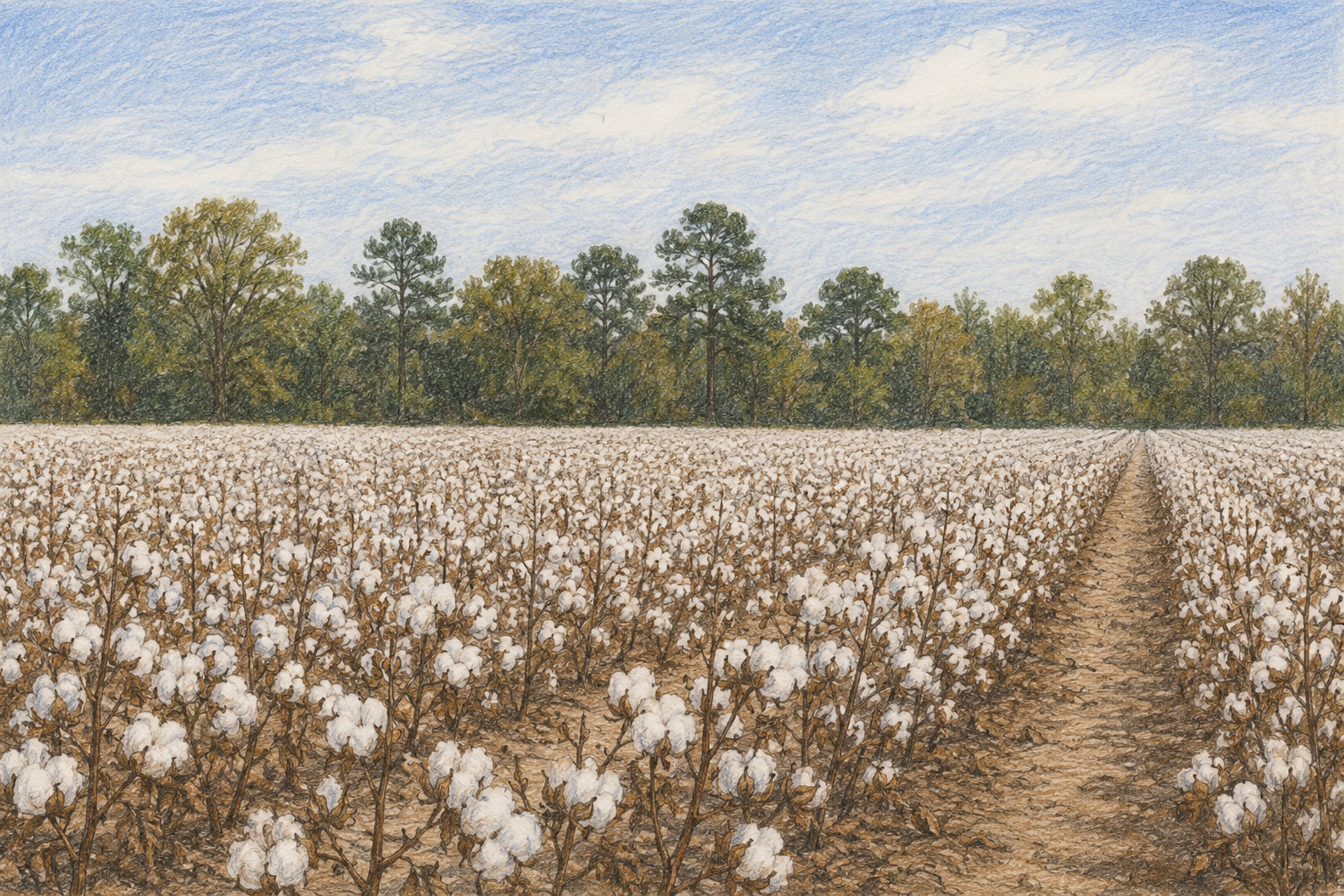
To be fair, the acreage has shifted around. While cities have grown, agriculture continues to decline. The year 1900 was the peak of 100 years of cotton farming in the state. “I wish I was in the land of cotton” used to be a real thing: six million acres of it were planted anywhere it could be planted (and some places it shouldn’t have). There are around 50,000 acres of cotton land today, and “old times here are quite forgotten.”
There’s a reason that cotton is gone. Many have learned just enough history to think it was due to the boll weevil, an insect which is commemorated by a statue in Enterprise (in case you ever want to make a pilgrimage). But the truth of cotton’s decline is much more complex. There were environmental, technological, labor, and political causes, but the biggest factor was that the global market for cotton changed. On the bright side, what was bad for cotton was good for trees, which grow well on lots of soils, even those worn out by continuous cotton cultivation.
I feel certain that if you could travel back to 1900 and tell an old-timer that there would be very few cotton fields in 100 years, he would have laughed you off his porch, because cotton was about all you could see in every direction.
That is the same thing someone would tell you today about Alabama’s abundant forest.
Unless he is paying attention.


Finally, Ray. I had almost given up hope after the last (distant) post’s compelling tease. This is quite interesting. Keep it up, please, but at a less leisurely pace. Saludos from México.
Thanks. Yes, I know I need to do better. I write better with a deadline. I’ll shoot for once per week.
Hi Ray, so nice to see you here! I have to admit I know so little about your State but hope to learn more as you continue posting your writings here.
I lived in Arizona for 3 years and was always amazed of the cotton fields seen there. Miles and miles of rows it seemed. In its own way, it was a mesmerizing view.
Again, welcome back to writing here and I know we’ll all look forward to your next chapter.
Leisa
I remember the same view riding in the car as a boy each Fall in the Coosa Valley. Most of it is pine trees now.
Good to see from you again Ray. Good forestry practices and tree improvements have grown us right out of a profitable crop. You know that. Imports don’t help matters.
I had the honor of picking cotton as a young kid on the family farm. No, not for pay but just hanging out with my babysitters who were tenant workers there. They helped raise me right. I think about the few vivid memories I have of those days when the roadsides looked like they had a little snow on them during picking time.
Philip
Good to hear from you, Phillip.
Ray, I just love reading everything you write! You are so gifted!
Thank you, Cathy. Good to hear from you, Missed you at the reunion.