“At one time in the world there were woods that no one owned,” wrote Cormac McCarthy in Child of God.
If you want to tell a story, start at the beginning. But there is a problem if your tale is about a forest. When exactly was the beginning?
I once attended a lecture on Alabama’s National Forests at which a government forester claimed that the U.S. Forest Service was enacting a management plan to restore public lands to their “original condition.” I raised my hand and asked when the forest was “original.” After a great deal of stuttering and stammering he admitted that what he really meant was before any logging.
That’s a beginning with which we can work. What did Alabama’s forest look like before anyone owned it – before logging?
My best guess is 1775, the year that naturalist William Bartram documented his travel through central and southern parts of the state. Bartram was a true “Renaissance man,” an explorer, botanist, artist, and writer, and his descriptions and drawings of plants and animals are the definitive narrative of the southern landscape before European settlement.
What Bartram described is something vastly different from what exists today.
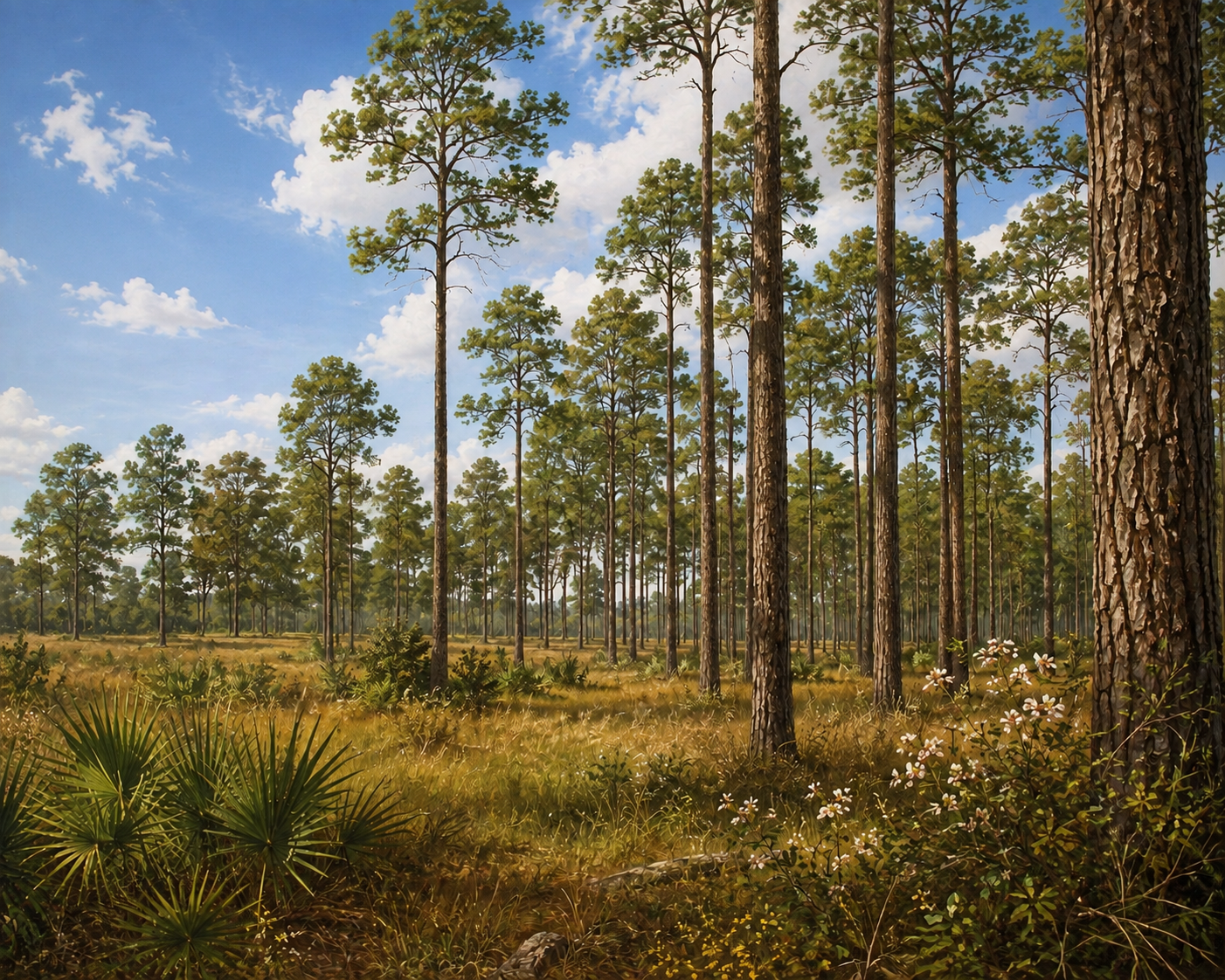
In what we now call the “Coastal Plain” he found longleaf pine savannas, vast areas occupied by “the stateliest pine trees that can be imagined.” This forest was open and prairie-like, with large, widely spaced trees “standing like columns or pillars,” and a ground cover of grasses, wildflowers, and shrubs. The openness of this forest allowed him to travel through on horseback. He accurately surmised that the longleaf ecosystem was maintained by frequent fires, which occurred both naturally and through intentional actions of the natives.
A reasonable estimate of the longleaf forest in Bartram’s time is 30 million acres. Today there are about three million, and much of that consists of young longleaf plantations. There is a lot of interest in restoring the ecosystem, and public and private agencies offer grants and other funding to encourage landowners to plant longleaf.

Along rivers and creeks, he found something entirely different. Great stands of massive hardwood trees including oak, ash, elm, baldcypress, sweetgum, and southern magnolia. Thick vines grew up into the canopy, and the groundcover consisted of ferns and lush vegetation. He described this forest as “cool, shady, and luxuriant.”
The bottomland forest in Bartram’s time is estimated to have covered six million acres. Today there is about 2.7 million, with most of that having been cut at least once.
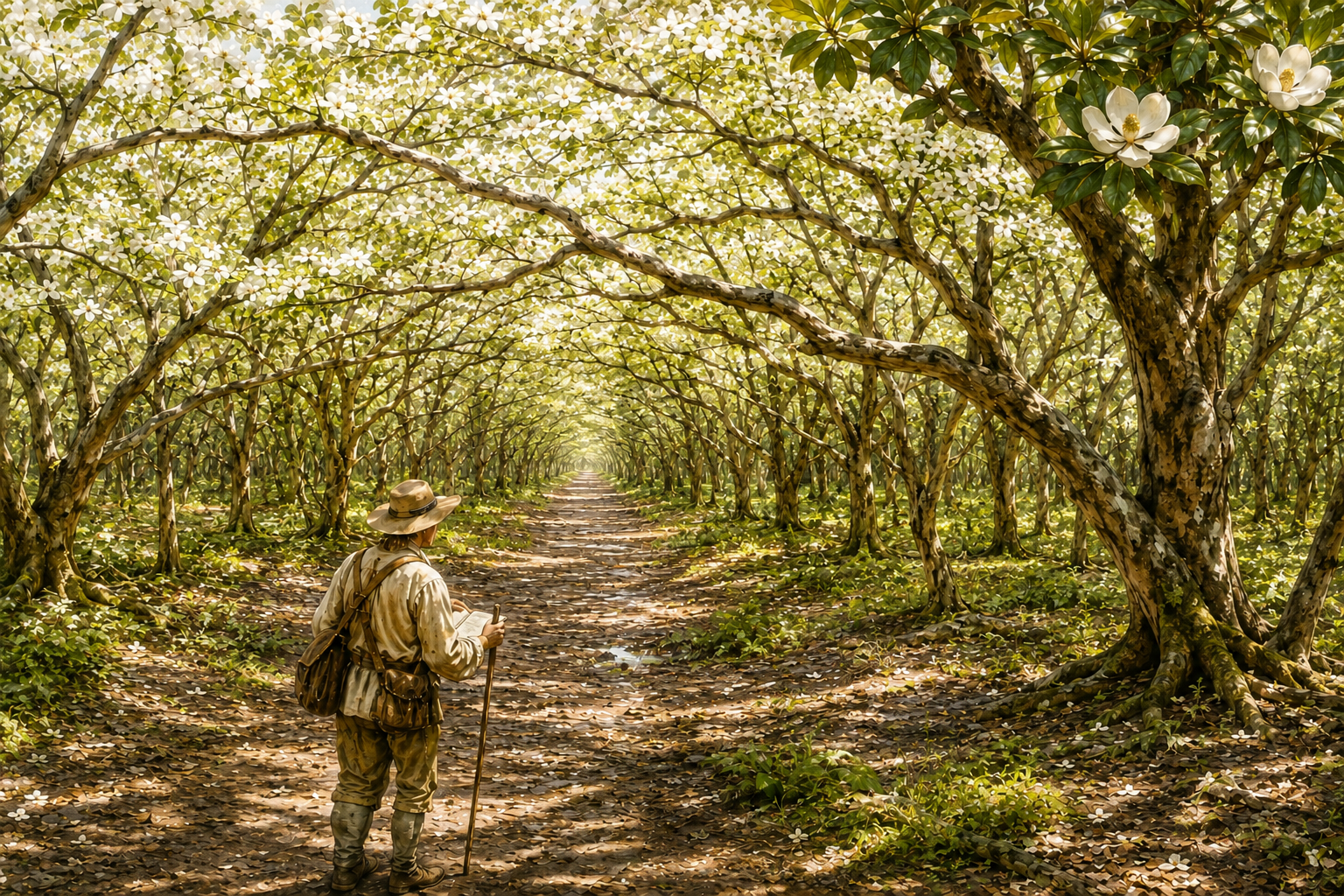
Just south of what is now Montgomery, Bartram described something foresters find puzzling – a nine-mile-long stretch of flowering dogwood trees so dense that it was a monoculture, punctuated occasionally by a southern magnolia. The curious thing about that is that dogwood today is found as individual trees scattered across the uplands. What he described does not exist today.

While Bartram did not travel through the hills and valleys of North Alabama, we can surmise what he might have seen from the writings from settlers in the early 1800s. Oak, hickory, American chestnut, hemlock, and various pine species covered this area. Most has since been cut and regenerated several times, and a substantial portion is now in pine plantations. American chestnut, which may have constituted 30% of this upland forest is extinct, killed by a blight over a couple of decades in the early 20th century.
The bottom line: the forests we have today are quite different than the “original.” The terms “virgin forest,” “virgin timber,” or “old-growth timber” simply do not apply in Alabama. Every forested acre that can be logged has been — several times. A tree over 130 years old is rare, and a group of trees that age standing together on an acreage large enough to be considered a forest is non-existent. There are a few exceptions, of course, but they are occupying land that is extremely hard to access – which is why they are still standing. These “patches” of forest exist in areas so steep, narrow, swampy, or rocky that no enterprising timber man ever figured out how to get in to cut them. We have lots of trees, but they are not as old as you might think. Next time I will tell you a little bit about how we got from Bartram’s “original” forest to that we have today.
Photos generated by AI


In the last post, you said you’d try to add to this at least once a week. Two weeks have passed, but that’s fine and dandy. No pressure.
I looked up longleaf pine and discovered it’s the state tree of Alabama.
Nice photos which I see are AI-generated. You’re a sharper man than I.
Interesting, señor. Keep it up, and saludos from Mexico.
Thanks. I have been unusually busy since I started this.
The AI thing is nice, but also a little creepy.
This is SO interesting – I’m going to pass it along to my husband, with whom I have planted about 30,000 (plus) trees on 120 scrubby acres in northern Minnesota.
Looking forward to the next installment.
Thank you for the encouragement. I’ve been involved with planting quite a few scrubby acres as well. Hope yours do well.
Good to see you writing again about something you know so well. Very interesting piece.
Thanks.
Well-written, Ray! When I worked in Columbus, restoring the Pine Mountain Trail to “original” forest frustrated me. Because of forest succession, it is really just picking a point in time. The dogwood forest south of Montgomery intrigues me. Looking forward to the next post!
Thank you. A dogwood forest is something I would like to see.
This was a great article you wrote, Ray. I really know little of your States forestry and certainly nothing before Europeans arrived and logging began. Because of what you wrote, it trekked my interest in seeing what’s been written of my State before the New Americans moved west to settle on open prairies. Eastern Red Cedar abounds here, primarily used as shelter belts now. I look forward to your next article!
Thanks Leisa.
Interesting thing about Alabama that I haven’t mentioned — we have prairie here as well. It stands on a satellite view of the state because it has so few pines (they won’t grow on prairie soils). It does however support red cedar and a few species of hardwood. A lot of the big cotton plantations were there before the war. It’s called the “Black Belt” for the color of the soil.
There’s lots of interest in some circles of restoring everything to “pristine” condition, which is likely in the same vein as what you mention as “original”. While I’d like to see that, the world is just a different place now. Fires can’t start and just run till they go out, nor does the landscape burn frequently enough to allow that to happen without significant loss. I often tell people that while aiming for things like pristine, original, old growth, etc is a noble endeavor, our current landscape, politics, norms, land fragmentation, fire suppression, and lack of acceptance of smoke don’t allow it. We can restore things to a point, but it has to be balanced with what’s realistic today. I’d love to see the dogwood forest, unbroken black belt prairie, and millions of acres of fire maintained LLP, but I won’t see it this side of eternity.
You are correct in all respects. I would add the “pristine” or “original” state of a forest (or land in general) is a philosophical notion that assumes that such is “better” than what we currently have. It’s all continuous change, this side of eternity.