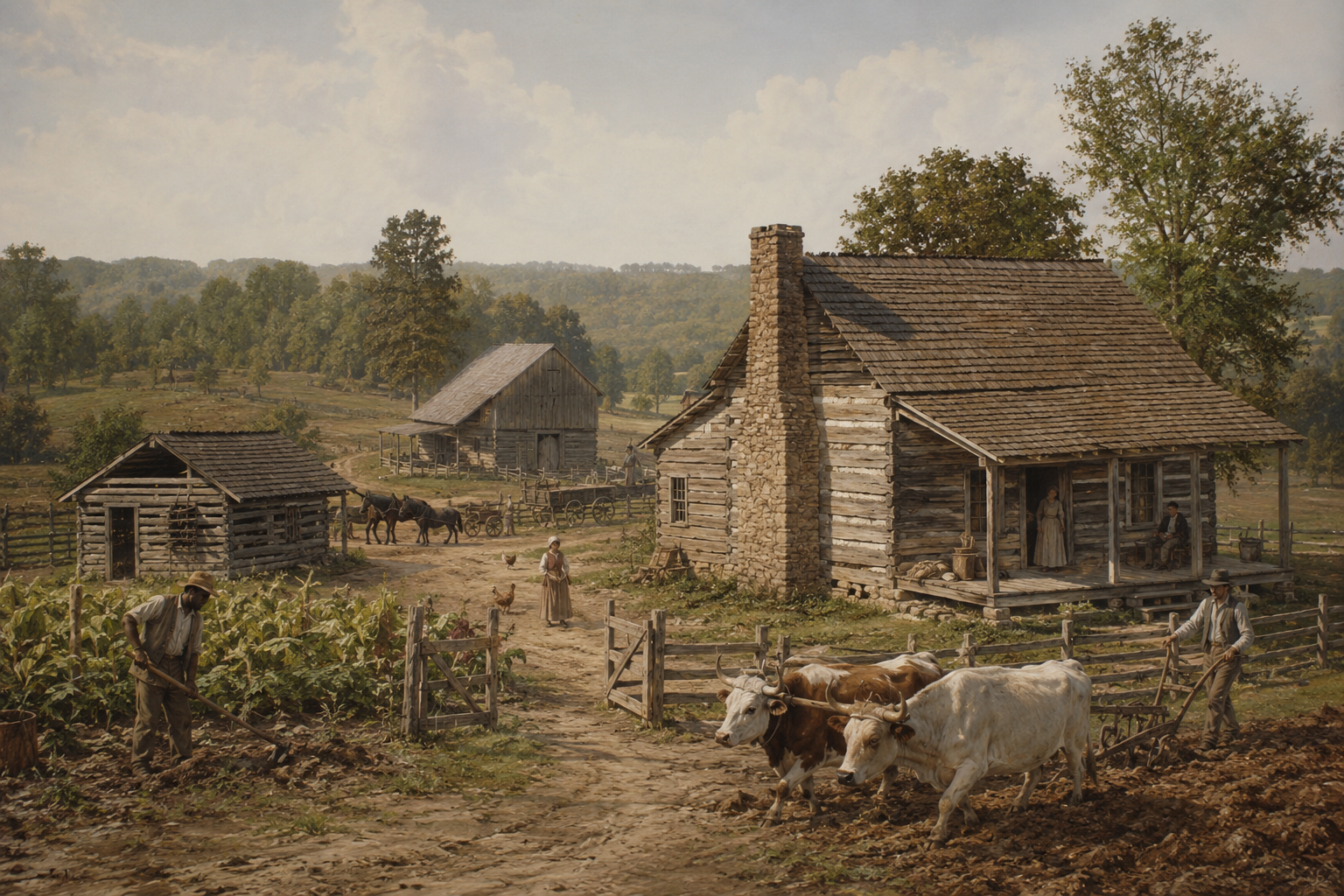
It took a little less than 80 years to transition from Bartram’s idyllic “original” forest, an unbroken landscape of “stately pines” and “lush bottomlands,” to a countryside that bore the marks of European colonial settlement. This change stemmed from a very American idea: that ordinary people could purchase land for themselves, work it with their own two hands, and build enough personal wealth to control their own destinies.
But before the land could be sold, it had to be controlled. Westward expansion into the 14 million acre “Mississippi Territory” followed the defeat of the British and the Creek Indian Nation in 1814. By 1819 Alabama had enough settlers to enter the Union as a state. By 1830 the native tribes were overcome and relocated to “Indian Territory” in present-day Oklahoma.
Back in Alabama, the territorial lands were surveyed into a rectangular grid established by the Government Land Survey System. This allowed land to be broken into parcels or lots which were offered by grant or sale to homesteaders at Government Land Offices.
Under private ownership, the towering longleaf pines and the lush hardwood river bottoms were more often seen as an obstacle than a blessing. Before a farm could be established, trees had to be cut and removed to prepare for homes and crops, and that was no easy task.
A typical homesteader cleared enough trees to build a small cabin and a few outbuildings, as well as clearing areas to grow crops. This was difficult, backbreaking labor. Trees were felled with axes and crosscut saws–called “misery whips” by settlers–and dragged to building sites by oxen, horses, or mules. The clearing and building process was gradual and often took place over several years. Once cleared, settlers planted corn, wheat, and vegetables and sometimes established fruit orchards. Rail fences were made from longleaf pine (or chestnut in the north) to keep free-range livestock out of the crops. The settlers initially relied on wild game as their meat source but soon hogs became the primary source of meat since pork could be preserved by smoking or salting. Once a few families had settled in an area, small communities developed.
The notion that Alabama was dominated by big cotton plantations and slave labor is false. The plantations were mostly prevalent in Alabama’s Black Belt Prairie (where there were few trees) and along major rivers. However, even small homestead farms eventually began producing some cotton by the 1820s. Cotton was a cash crop, and cash was scarce for subsistence farmers. Even though more land was cleared for cotton, the overall effect on the “original forest” was marginal.
Up until the Civil War, few areas of Alabama had anything resembling a large-scale forest products industry. Small sawmills were scattered across the state, usually along major creeks or rivers, but these did not become transformative until after the War. The same small scale held true for other commercial enterprises such as charcoal, turpentine, and crossties for the burgeoning railroad business.
After the Civil War, however, a new era would begin. The forest of Alabama was about to be transformed into a landscape that Bartram could not have imagined.


Still informative and interesting. Keep it up. Please.
Thanks. I’m not having fun yet. Feels like a book report.
Appreciating this historical context of Alabama’s landscape long, long ago! I look forward to your next continuing writing, Ray. You’ve not lost your touch. Not a book report but a history lesson!
Thanks Leisa. You always say nice things. I appreciate it.
Our ancestors were a different breed. They were raised the hard way and produced a generation like no other. Even my generation was conditioned to work hard and save. Our current generation will struggle in adulthood I believe. We shall see. I was born in 1951. I enjoy your writings very much. You are talented like your Mom. She and my sister were in school together, I think. Her name is Brenda Hammond McGrady. Thanks for sharing your talents, Deborah Hammond Box
Thank you for your thoughtful comments. I agree that each generation is getting “softer.” There is good and bad in that. As long as “times” are good, soft gets by. But anyone who thinks times will always be good is delusional. I fear we have become too soft.
I’ll be sure and mention you to mom.